I’ve argued before, alongside others, that the main inhibitor of ubiquitous and perpetual internet connectivity at a global level isn’t a technology problem, it’s a business model problem. Mostly the tech exists to put the signal everywhere. What we overlook when we say this is, that while that is true, it’s unsavory to point out that many of “those users” are not valuable – that the population covered won’t make a good return on business investment. So, even if you covered the initial cost of the equipment outlay in those areas with a subsidized government funds, without a proper business model to support the ongoing operations of running the network, then the ROI would be weak and maybe even negative.
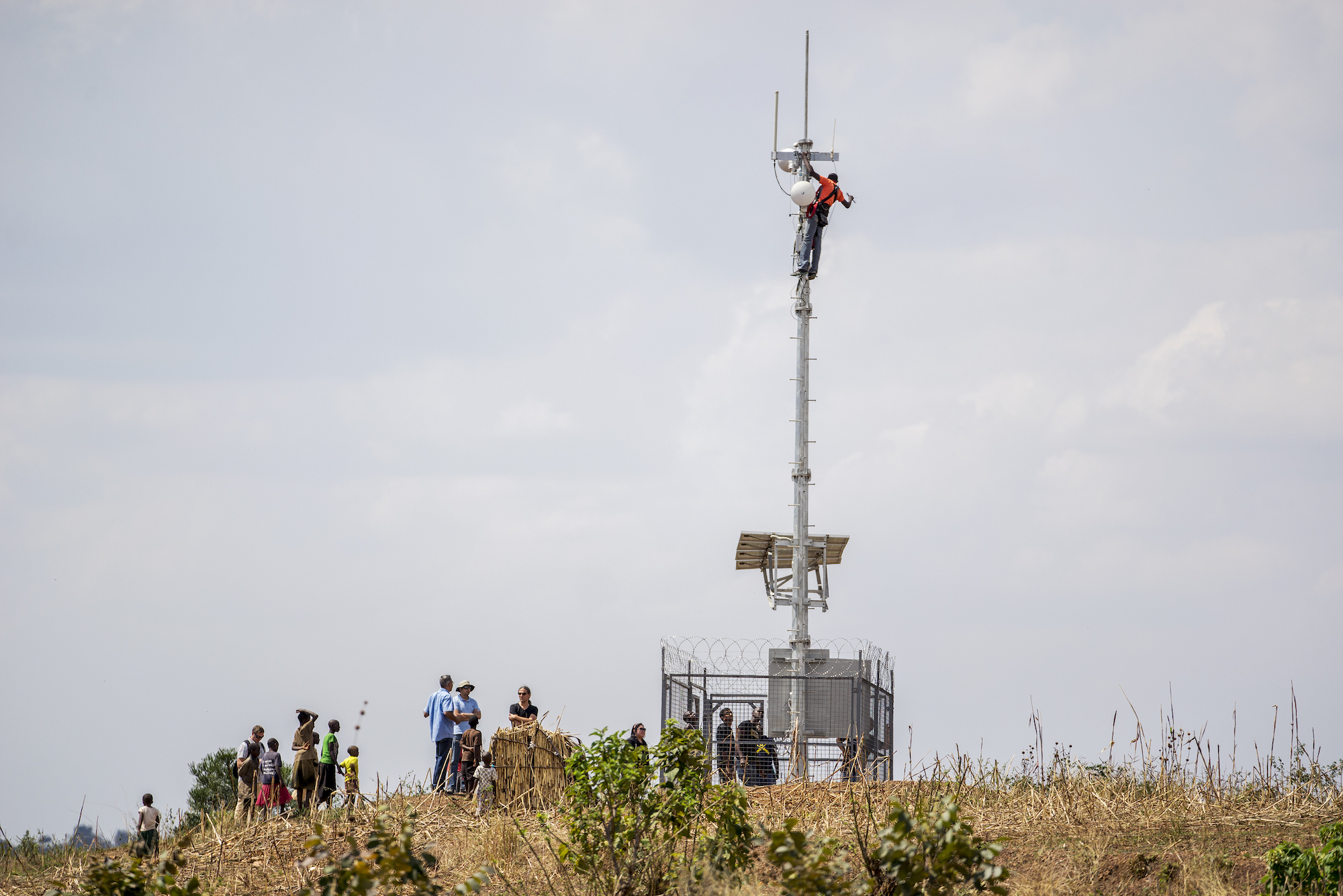
A low cost tower set up in rural Africa
The unspoken technology issue
Many of the incumbent ISPs and mobile operators have sunk too many resources into legacy technology, and then subsequently, outsourced their technical capacity and platform knowledge to foreign firms. This leaves them in an unfavorable position when it comes to new technology that would decrease the cost of rollout by up to 90%, or of taking advantage of how software is changing the way networks work. Due to heavy GSM investment, the industry thinks it best to switch those from 2G/EGDE to 3G. This misses the mark though, it’s iterative change driven by sunk costs, ignoring the fact that we’re moving to a data-only network world. GSM is a dead man walking. IP networks are the future.
It’s not just me saying this, two years ago Deloitte was saying,
“African MNOs should create business models around smartphone users and brace for the rise of the data exclusives and data centric phone users.”
This then provides the opportunity. This is the time to bring new networks without legacy business or technology paradigms, and the ability to apply web-scale economics to the network itself, backstopped by new open software stacks and business models that don’t rely solely on end-user payment.
Fortunately at BRCK we’ve been able to find great investors and strategic partners who see this bigger picture and understand the investments needed to make change happen in this connectivity industry of ours. BRCK, alongside some other firms, are on the forefront of changes happening across all types of data pipes, at the infrastructure level all the way through to the retail side – for both people and things. And as we start running the numbers it becomes increasingly clear just how big of an opportunity this actually represents. It only helps that many incumbents are stuck in aged technology stacks and legacy business models, so the window for positive change is here and profits are substantial.
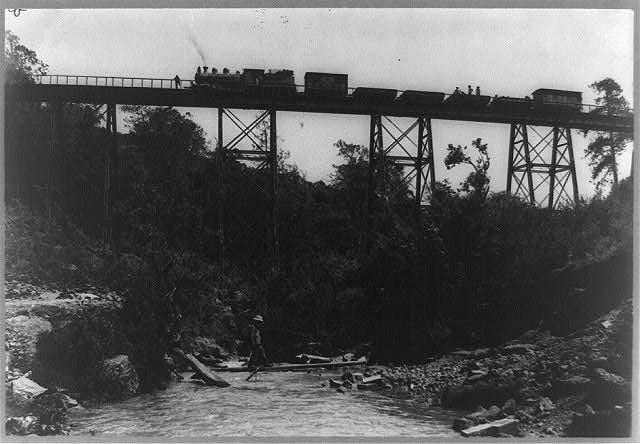
East Africa Railways train
A new railroad
I tend to think of what we do in the connectivity space as similar to our forebears building railroads, making it easier, faster and more efficient to move data and connect far-flung parts of the world. The 1990’s brought us the rebels in the form of scrappy upstart mobile operators and ISPs, they were real cowboys and renegades then! Inspiring leaders, courageously trying everything from pre-paid credit models in Africa, to thinking of mobile credit as cash, to digging the first fibre cables into the hard parts of the continent. Regrettably, these cowboys have handed the reins over to our modern day robber barons, sitting fat and happy on their oligopolies (or monopolies), and making damn sure that no one else has a chance to build something better if they can help it.
I like to think that at BRCK we are building the new connectivity railroads. The tip of the spear for us is unlicensed spectrum, where we take advantage of the ability to roll out public WiFi hotspots without much in the way of regulatory or political hurdles. We layer this with a free consumer business model, so that anyone who can get that signal can connect and take advantage of the whole internet. The underlying economics of the Moja platform are built around the idea of a digital economy. Businesses create engagement tasks that users can complete to earn value within the system. Users then spend their value on faster connectivity, premium content, or additional services. The flow of value into and out of the Moja platform creates the monetary value necessary to profitably run the network.
This is just the BRCK model though, and as I sit on some global boards and in meetings I hear of the others trying their new models as well. New technology stacks, driven primarily by open source software (and some key open source hardware plays), are a big part of the significant decrease in the cost profile (both CapEx and OpEx). But again, the business models… this is where we see the real changes coming and I’m excited to have a front row seat.
As these new railroads are built, by us and others, there lies such great opportunity for economic growth, social development, and business profit.
Sponsor this article: casino cashlib and casino en ligne yggdrasil
]]>What I find interesting is that everyone wants to benefit from a basic underlying availability of connectivity, but few understand what it is or why it is so important. If you’re with me at a public event, I’ll eventually spout off something along the lines of, “you can’t have a 21st century economy without power and connectivity.” This is my simplified way of stating that for any industry to be meaningful on the world stage (or even their own country stage), they need the ability to move data. If power and connectivity are the foundation, then the aforementioned ecommerce, agtech, fintech, and others are all pillars that stand on that foundation.
Economic growth
I’ve written before on how smartphone penetration has reached critical mass and proceeds on a noteworthy trajectory across Africa and other frontier markets. Africa, coming from a largely 2g/Edge based on old legacy GSM technology will have some of the highest growth rates in mobile data subscriptions globally, driven by chat apps and mobile video, as we transition to data-only networks. In 2022, there will be eleven times more mobile data traffic in Central and Eastern Europe and Middle East and Africa (Ericsson 2017).
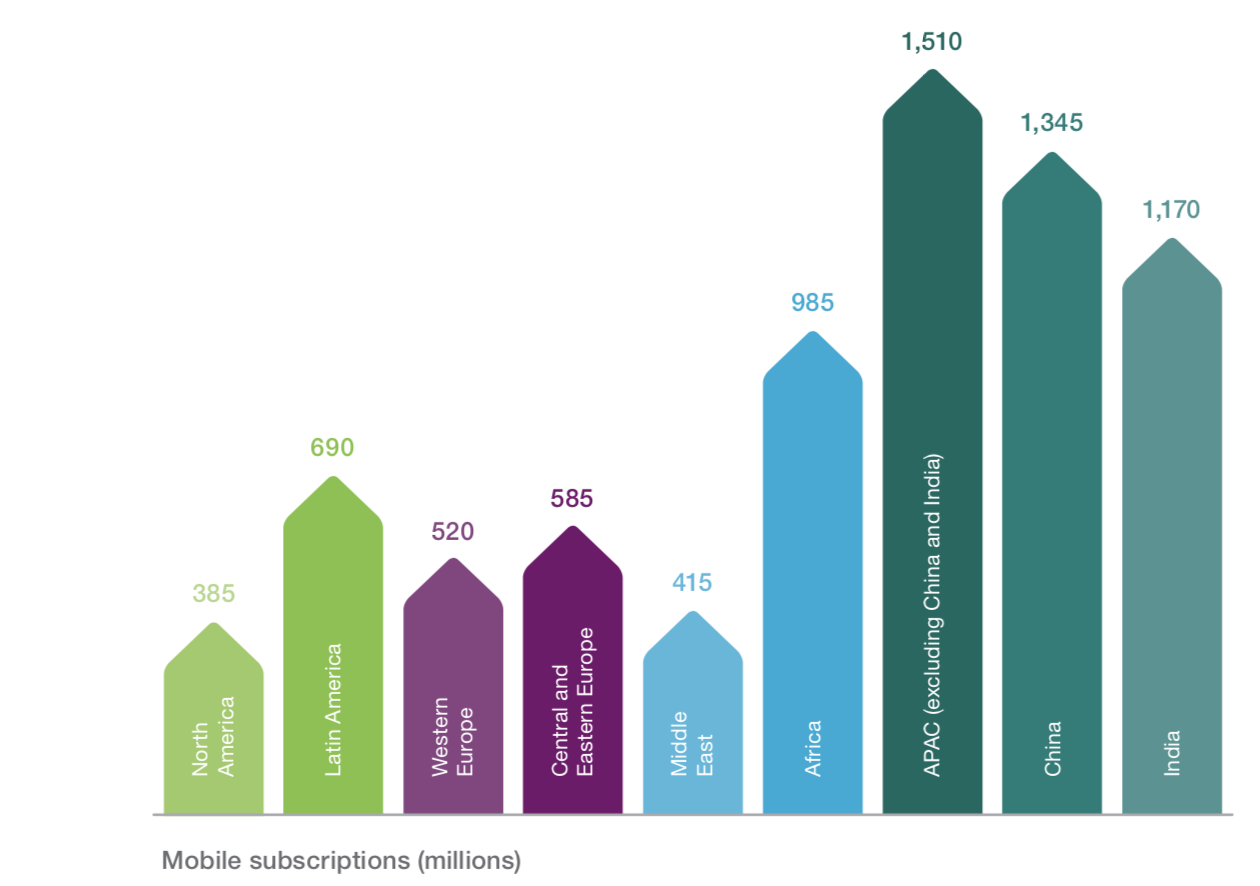
Mobile subscriptions (global)
- 250M smartphone subscribers in 2016
- 770M by 2022 (Y-o-Y growth of 30%) (Ericsson 2017)
- Over half of mobile phone shipments into Africa in 2016 were smartphones (Deloitte 2017)
All of this means that there are millions of new customers available for new, smart, and data-intensive financial products, agricultural services, marketplaces, logistics, and the list goes on. This is why we’re seeing the rise and rise of startups in these spaces, as well there should be.
What we’re not paying attention to is this: the market is still smaller than it could be.
Imagine that you’re finding amazing market traction with your new mobile lending app, or with your logistics system, or with your online goods marketplace. Imagine that you’re doing well, however did you know that you’re only reaching 20% of the people who own smartphones in the country…. Oh, right, that’s the piece that’s surprising! You could be doing even more, growing faster and capturing more market share if only the other 80% of smartphone owners in your market could afford the costs of getting online regularly to use your service.
This is where BRCK is stepping in with our Moja platform (free to consumer internet). You’ll benefit greatly from our growth. We’ll benefit greatly from your growth.
Social development
Even though I’m largely driven by the economic reasoning for connectivity alone, since I believe that the best way for us to make significant change in Africa is to grow wealth for everyday Africans, there is a strong social argument for widespread and affordable connectivity as well.

Connecting an additional 2.5 billion people to the internet would add 2 trillion dollars per year to global GDP and create 140 million jobs
- It enables improvements in health (Deloitte 2014)
- Unlocks universal education (Deloitte 2014)
- Strengthens civil society through public services, social cohesion, and digital inclusion (Deloitte 2014)
It turns out that if we connect people to the largest, greatest network of knowledge and information in the the world, then a lot of great social benefits are realized across a number of important areas. It’s hard to argue against more jobs, better education, better healthcare, more informed citizens, and a stronger civil society in any country.
Connectivity is the foundation
Like everyone else not involved in the plumbing and distribution of the internet, I used to think of this only academically. It’s easy enough to understand and think through intellectually. However, I found that in living it, in dealing with the practicalities of the internet, in coming to know the end-user I began to appreciate just how important connectivity is. Building a new app or service can have big effects, changing the affordability equation for connectivity and you send a shockwave reaching everyone, everywhere.
Sponsor this article: best iphone casinos in canada and grand mondial casino
]]>
As a child I grew up in Sudan and Kenya. When I lived in Sudan, we had no power most of the day or night, and I kept myself busy with quite a bit of reading. Reading for escape, for adventure. Like many, I grew to love Tolkien’s hobbits and the Lord of the Rings. I began to think of hobbits and Shire folk again recently, which inspired me to look up quotes from the great wordsmith Tolkien.
“Even the smallest person can change the course of the future.”
–J.R.R. Tolkien
This week I’m a part of the Unreasonable Goals program, where 17 business men and women are gathered, since they’re focused on solving some of the world’s most intractable issues. It’s filled with remarkable people working on some very hard things, in very creative ways.
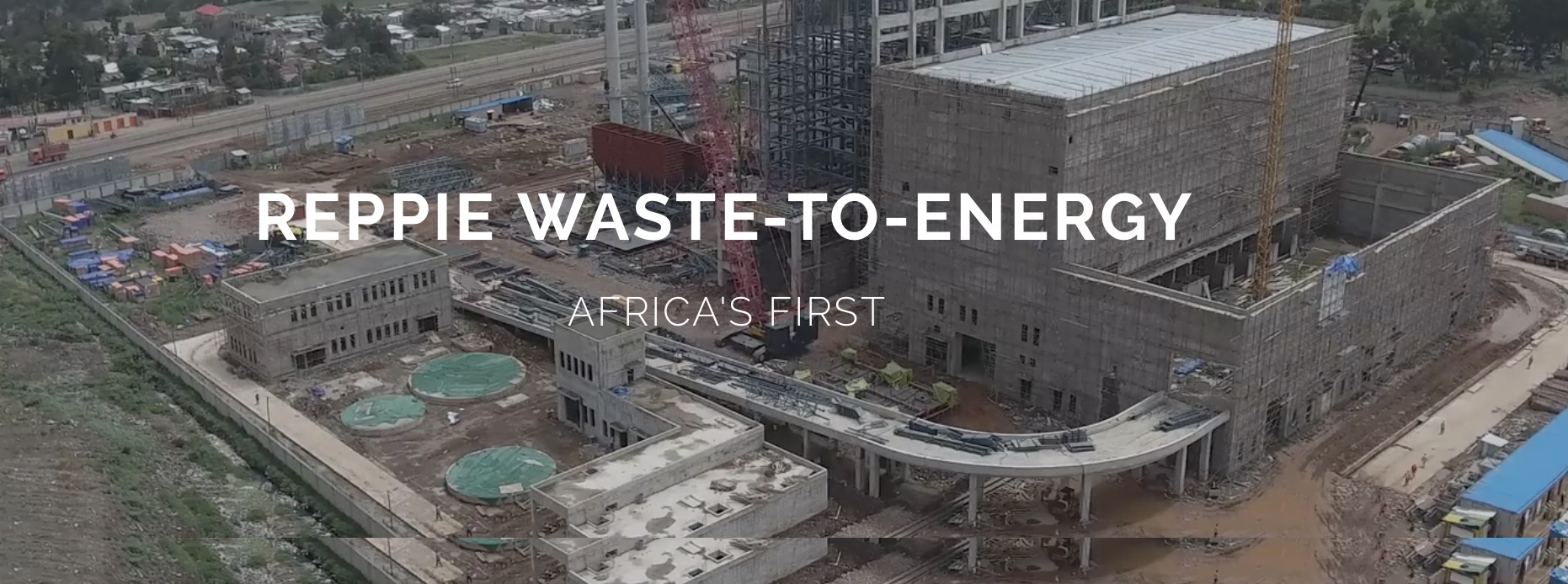
Take for instance, Samuel Alemayehu of Cambridge Industries in Ethiopia. He takes in an ungodly amount of waste and then proceeds to create energy, paving bricks, and a slew of other byproducts that provide jobs and opportunities for 50,000+ Ethiopians.
Or, how about Gayathri Vasudevan of LabourNet, working to to provide jobs and enable livelihoods for 10 million informal sector workers in India.
I mean, this is heady stuff, with people not just dreaming and building, but actually doing it. And, there’s 15 more CEOs of companies that are all here working on *things that matter*, that push the envelope. It’s no exaggeration to say that some of the individuals in this room will make a real dent in the world, and that you’ll see their names in even bigger lights one day.
In my Tolkien quotes journey I also came across another quote. One that has been gnawing on me all week:
“It is no bad thing to celebrate a simple life.”
–J.R.R. Tolkien
We sometimes overly celebrate those who tilt at windmills, who climb mountains, who conquer all before them. Some of them live a good life, a fulfilling one. They are called to this, their gifts and skills almost compel the new reality that they stamp upon the world.
And we forget… We forget that there is a life equally well lived for those who live a simple, quiet life. Sometimes they support those on grand adventures, sometimes they have a resounding impact on their small community, and sometimes they softly raise a family, keep the engines going in a company, or happily bake cakes (and everyone loves cakes!).
I’m grateful to be amongst the genius and talent in this room. I’m similarly thankful when I reflect on the many who live a quiet and equally accomplished life.
]]>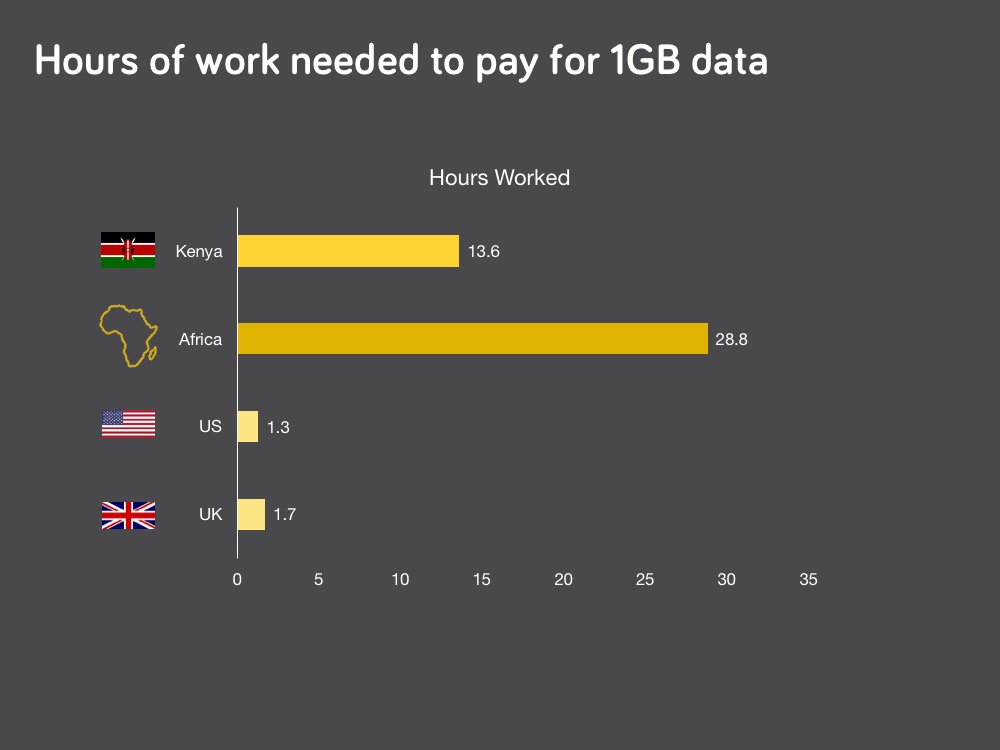
It takes someone in Africa four days of work to earn 1Gb of internet. In the US and Europe, it takes just two hours to do the same. (note: see bottom for the math on this)
Connectivity can be generally broken down into two buckets:
- Accessibility – which is generally about having the signal for the internet and the devices to connect to it.
- Affordability – the ability to pay for the internet.
There’s a good piece in Wired about the slow down in connectivity around the world. We’ve made great progress in the initial half of the world connecting to the internet, but the remaining half is coming along a lot slower, and at a decreasing speed each year.
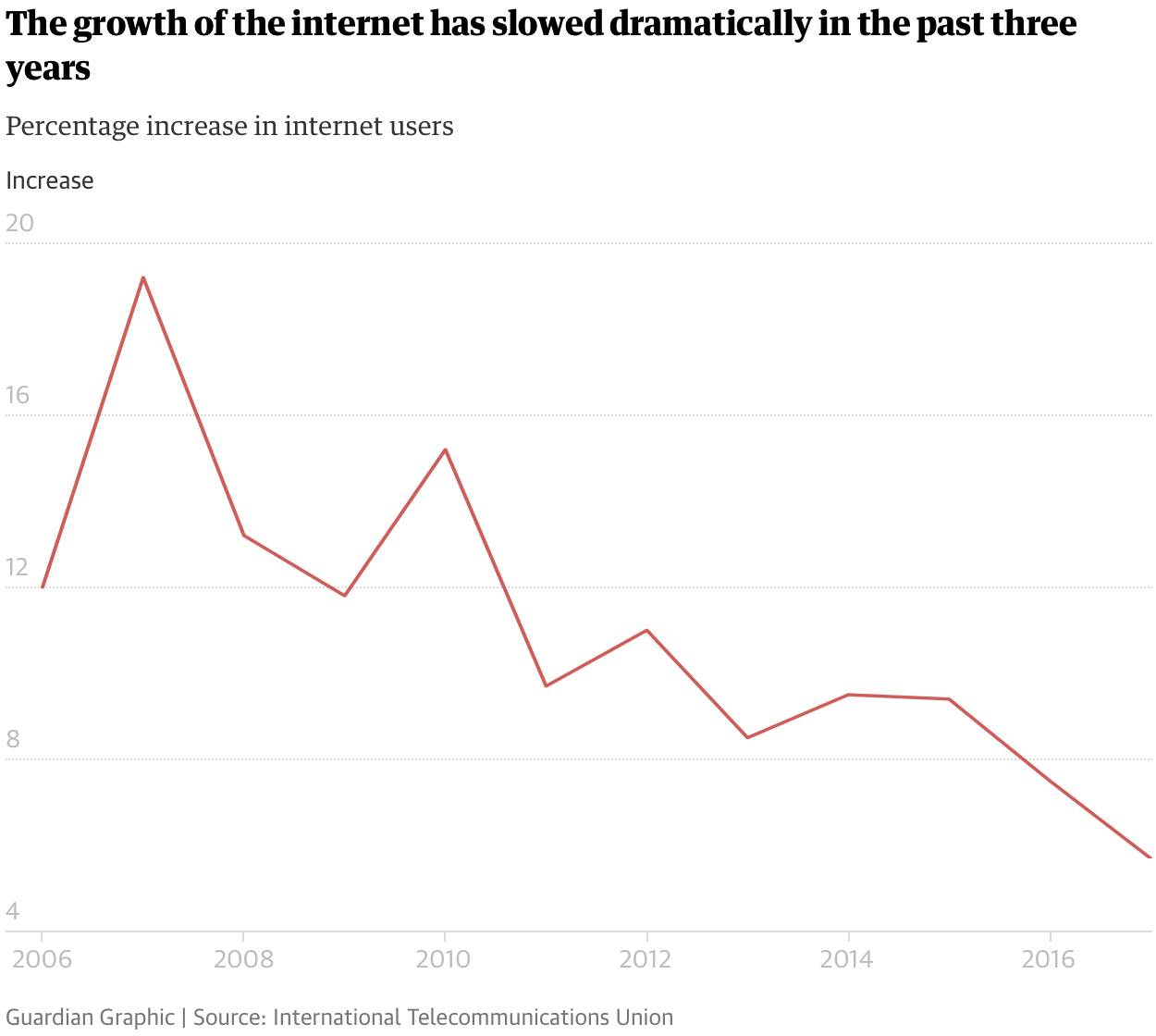
“The data shows that growth in global internet access dropped from 19% in 2007 to less than 6% last year” The Guardian
Why?
For the last two decades we’ve been focused on some pretty big population numbers as well as more wealthy demographics; connecting cities (in both first-world and frontier markets) and the relatively prosperous populations of the world wherever they may be. Currently, on the accessibility front we’ve been forced to work in harder areas with less population density, where the numbers for a cell phone tower are slower to show their ROI, and where frankly it’s not worth using our older technology and our older business models to unlock the internet to that population.
So we come to an interesting time in history, where there is a lot of discussion about, “connecting the last 3 billion”, but not a great deal of courage in doing so.
Sidebar: since I’ve been sitting on an airplane for many hours, I watched the movie 1970 movie Patton, which is likely why I’m thinking so much of courage. In it he quotes Frederick the Great (possibly wrongly attributed) as saying:
“L’audace, l’audace. Toujours l’audace.”
“Audacity, audacity. Always audacity.”
And it is about courage. Most people look at the problem of the internet and think about current tech, or even future tech. They try to do something a little bit cheaper, maybe the go all out and and try something truly mind-blowing, such as balloons, satellites or drones. And, they each do play a small part. But, that’s it, small. We’re at a point where even these seemingly world-changing technologies are relatively small since there is a bigger picture that eclipses tech accessibility.
The big picture is that the internet will be free. Everywhere. Eventually.
Which means connecting the next 3 billion is a business model problem, not a technology problem.
If the is true, then let’s keep investing in these marginal accessibility changes. We need them, we truly do. Every time we get a new Viacom satellite, a Safaricom cell tower, a Google Loon balloon, or a new terrestrial cable dug across Africa or Asia, we get a needed marginal improvement. We push the costs down and the accessibility equation goes a tiny bit higher.
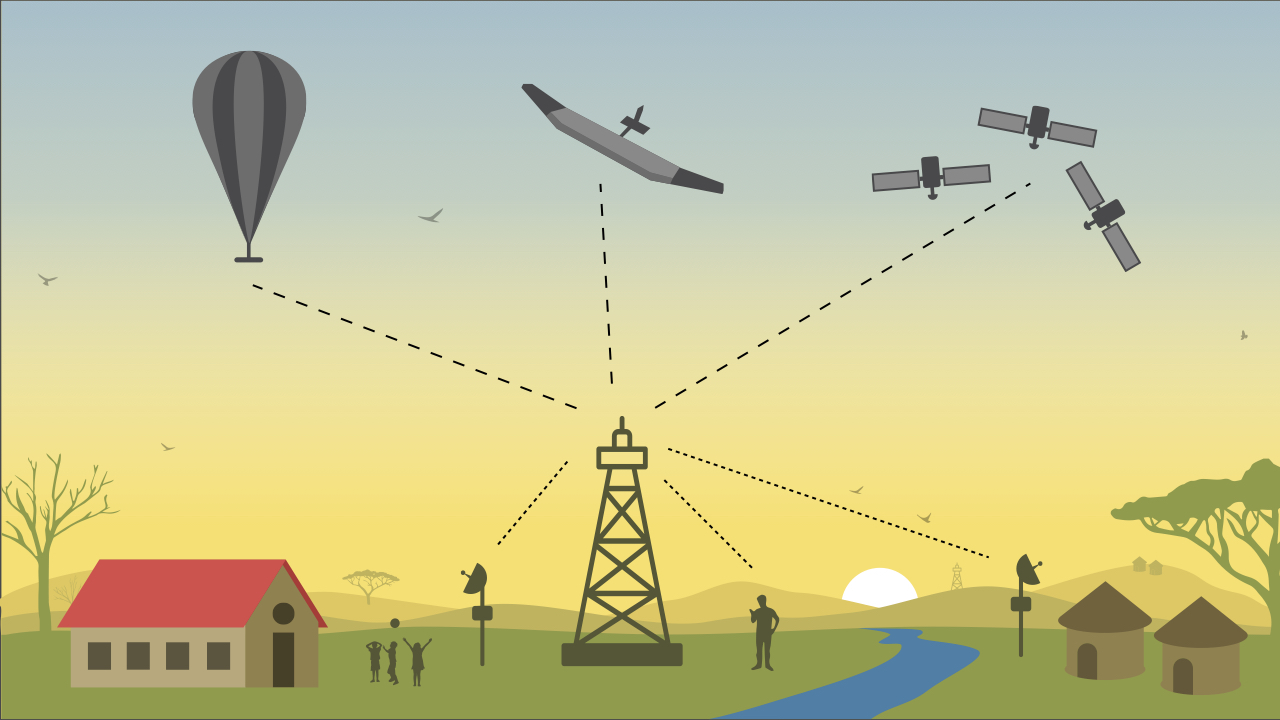
But back to courage. In our plans to connect the world to the internet, it doesn’t take a great deal of bravery to invest in a little bit more infrastructure. For these types of initiatives we’ve had our formulas for a decade or more, and we know they work. A few accountants and legal to check the boxes and a couple million more USD gets spent. We know how to charge for it, and that business model has seen but iterative change in two decades. We’ll always need cables and satellites, but in the world where the internet is free for everyone, it’s the business model that needs the most work.
So, how do we solve this business model for free internet? After all, the internet isn’t free, someone always pays.
It doesn’t come from charging a consumer who has limited disposable income. Just like the internet is moving to free in most public spaces in the US and Europe, I believe it will be the same in most of the rest of the world. The answer comes in looking for indirect revenue streams, and there are multiple paths to this.
This is where the big companies have let us down. Not due to their lack of investment, but to their lack of creativity. Whether it’s with satellite companies who provide low cost subscriber models, helping a moderate percentage more of the population get online regularly, or the Google Loons that side with telecom oligopolies, or the ISPs and mobile phone companies that are too deeply entrenched in their legacy business models to make any meaningful change.
Large organizations have a lot of resources. But… these same large organizations don’t think creatively enough about the solution.
Too many resources tends towards lazy problem solving. After all, if you’re a heavyweight going up against a featherweight, your only strategy need be bludgeon your competitor to defeat. In our world, a lot of money starts feeling like a hammer that you can start bludgeoning with – which tends towards solutions like the original “Free Basics” from Facebook, which looked a lot like an organization trying to do the right thing and then realizing that they couldn’t afford to give everyone the whole internet for free, so instead tried to make a good bit of it free – and ended up with a useful walled garden that set a lot of people on edge.
Compounding this is that the people making decisions around the initiatives at these larger organizations are not the entrepreneurs who built the company, they’re middle managers who like to reduce their risk profile inside the organization so that they can maintain their nice salaries and perks.
But, we can make the whole internet free, and we don’t have to buy it. What we need is a bit more creativity in coming up with new business models that represent the future of connectivity, not the past.
So, if big organizations aren’t the answer, and old infrastructure models are just iterative change, then what is the answer?
It’s a combination. Matching up the resources (and capitalist business models) of these large organizations to get these new users onto their platforms, and the creative solutions that come from smaller, hungrier companies give us a wonderful blend. When these two come together, interesting and explosive change can happen.
I’ve seen all of this first hand. Both the marginal change of the aforementioned global organization efforts alone (or worse, paired with some other large organization), as well as the magic of what happens when one of them works with a smaller company that has a real ground game and understands the problem from a different level.
I’m convinced that we’re solving this right now at BRCK, and that’s due in no small part to the infrastructure team we’ve had the chance to work with at Facebook. We’re not the only ones either, I’m seeing some other companies working on some pretty neat solutions too that gives me optimism for actually solving this problem. The only thing we need is more of the large companies to embrace some of these changes and work together with the companies on the ground in Africa, Asia and Latin America.
Appendix
I worked with Akhil, one of my interns, to try to come up with a general number of “hours worked to earn 1Gb of data”. We couldn’t find anything online like this, so took a crack at it in the afternoon. However, I’m sure someone else could get an even more accurate, country-level view than us. Here it is:
Kenya
- % of monthly income spent on 1GB = 9.72% (source: A4AI)
- Average number of hours spent per week for earning the monthly income = 35 hrs (including part-time work) (source: Kenya National Bureau of Statistics)
- Total number of hours spent per month = 35 X 4 weeks = 140 hrs
- Pro-rated % of hours worked per month for spending on 1GB = 9.72% of 140 = 13.6 hrs
Africa-wide
- % of monthly income spent on 1GB = 18% (Source: Reuters)
- Average number of hours spent per week for earning the monthly income = 40 hours (Source: ILO –> however this one is contentious given I’ve just taken the average of where most Africa countries are i.e. between 40-45 hour bracket)
- Total number of hours spent per month = 40 * 4 weeks = 160 hours
- Pro-rated % of hours worked per month for spending on 1GB = 18% of 160 = 28.8 hrs
United States
- % of monthly income spent on 1GB= 0.84% (this is the North American average) (source: A4AI)
- Average number of hours spent per week for earning the monthly income = 40 hrs (source: Bureau of Labor Statistics, USA –> please note I’ve taken the average of 25-54 years old since total population average hours/week is 34.5, which seemed a bit too low given it accounts for 16-20 years as well)
- Total number of hours spent per month = 40 X 4 weeks = 160 hrs
- Pro-rated % of hours worked per month for spending on 1GB = 0.84% of 160 = 1.34 hrs
United Kingdom
- % of monthly income spent on 1GB= ~1% (this is the Europe average) (source: A4AI)
- Average number of hours spent per week for earning the monthly income = 42.3 hrs (source: Eurostat)
- Total number of hours spent per month = 42.3 X 4 weeks = 169.2 hrs
- Pro-rated % of hours worked per month for spending on 1GB = 1% of 169 = 1.69 hrs

We had an idea of what we were getting into back in October 2013, but none of us were sure where it would actually take us. All we knew then was that the barriers to creating hardware had dropped enough for us to get into it, that there was a problem in the internet connectivity space in Africa (and other frontier markets), and that we had the right mixture of skills, naiveté, and optimism to figure it out. Over the next 12 months we grew to a team of 10 that had this the desire to meet a big challenge and believed we could do hard things. As I write this, 8 of those 10 are still at BRCK.
In the intervening years we’ve built 3 full products and taken them to market (BRCK v1, Kio Kit, SupaBRCK), and a fourth (PicoBRCK) that is still in R&D. That alone is quite an accomplishment. I hadn’t known back in 2011 when the idea for creating a device was first hatched, just what the life cycle of building a hardware+software product would be. I do remember having a conversation with an old friend, Robert Fabricant, that I thought we should be done with the first one in about a year. He laughed and said it would be at least 2-3 years. He was mostly right.
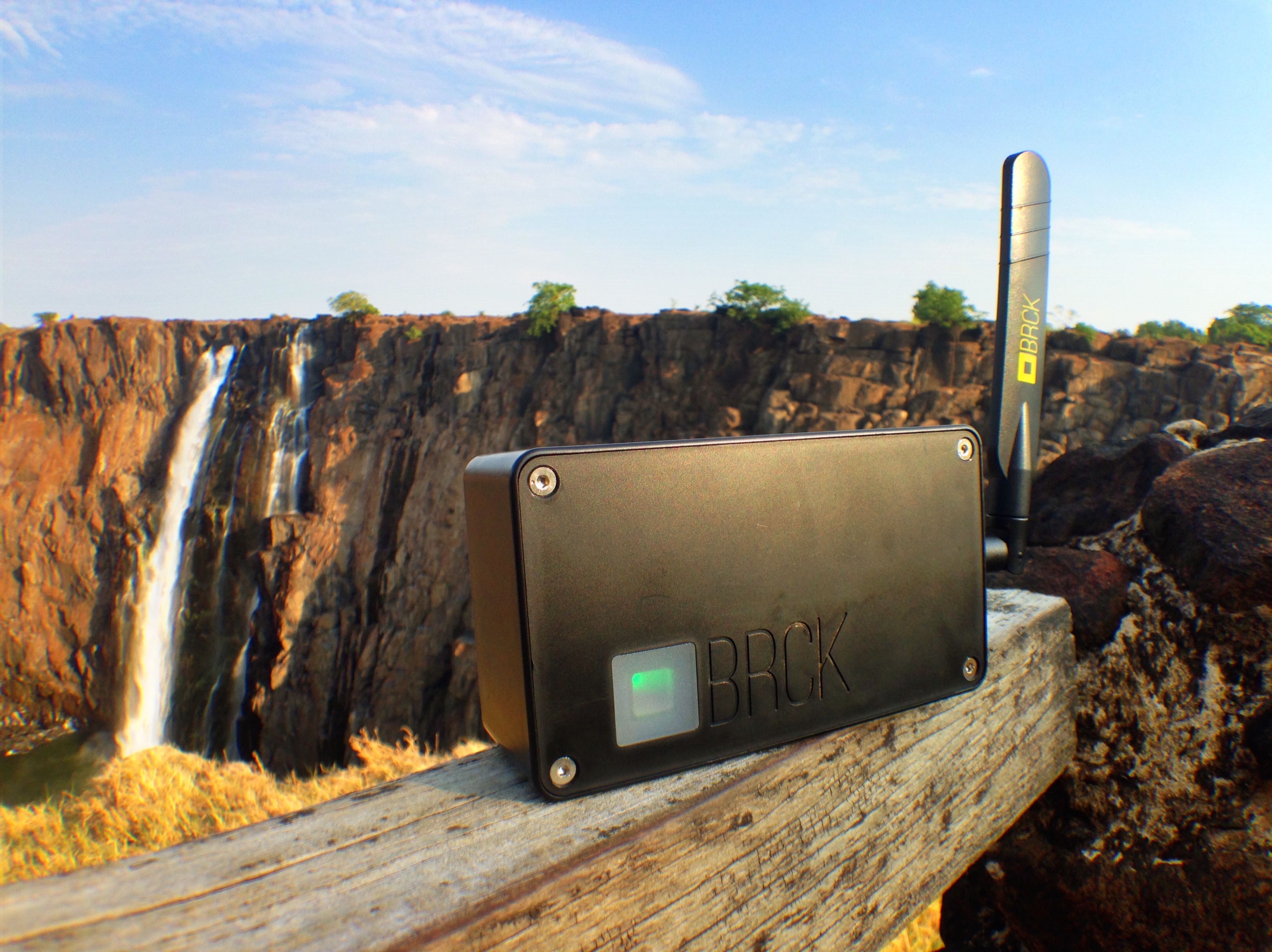
The BRCK at a dry Victoria Falls
I’ve since learned that it takes approximately 18 months for a product to go through the concept, design, testing, productization, and first samples stages. Then it typically takes us another 9 months for iterations and small fixes on hardware to happen, while that same time is spent concurrently hardening up the software side of things. For example, our most recent SupaBRCK took approximately almost two years from conception to product, and then another 6 months of continued fixes/changes to the low-level software and the hardware before it worked well consistently.
Asking the Right Question
You would often hear us saying, “Why do we use hardware designed for London or New York, when we live in Nairobi or New Delhi?” as a way to frame the problem we thought we were solving. It was only in late December 2014, after we had shipped the BRCK v1 to 50+ countries, that we realized we were only partially on the right track.
It turns out the problem isn’t in making the best hardware for connectivity in difficult environments. Sure, that’s part of the equation – making sure that you have the right tools for people to connect to the internet. But the bigger question involves people, who is connecting to the internet and who isn’t? If, after many years of building BRCK, we had built the best, most rugged and reliable solution for internet connectivity, that would be something we could pat each other on our backs for. However, if the problem instead was “How do we get the rest of Africa online?”, and we were able to solve that problem, then that was a legacy we’d be proud to tell our children about one day.

Sitting in our tiny office around Christmas 2014, we started thinking hard about this bigger issue and began doing deeper research into the problems of this loosely defined “connectivity” space. We started doing some user experience research, manon the street interviews, to figure out what the pain points were for people in Kenya.
Connectivity can generally be broken into two buckets:
First, accessibility – can I connect my device to a nearby signal?
Second, affordability – can I afford that connection?
The results were quite telling, it was definitely about affordability.
For everyone who’s not deep in African tech, let me lay out some interesting numbers for you. Accessibility in most of the emerging markets has been moving rapidly since the mid-2000s when we started to get the undersea cables coming into the continent. These cables then went inland and started a rapid increase in available internet connections and wholesale internet costs decreased rapidly. Since 2008 we’ve had more than one million kilometers of cable dug across the continent, and we have over 240,000 cell phone towers. Concurrently, the mobile device prices continued to drop globally, and by 2016 we started to have more smartphones imported into Africa than non-smartphones.
Reaching deeper into the market research, we started to study this affordability problem.
“A4AI found that the average price of 1GB prepaid mobile broadband, when expressed as a % of average per capita Gross National Income (GNI), varied between 0.84% in North America and 17.49% in Africa.”
It turns out that in almost every country in Africa, there is a consistent ratio among all the smartphone owners in a country: 20% could afford to pay for the internet regularly, and an incredible 80% couldn’t.
Interestingly, when we looked at who else was working in this connectivity space, almost everyone was focused on accessibility, not affordability. Those that were focused on affordability thought that just making the price cheaper was enough. What we’ve seen is that if you just make “less expensive” subscription WiFi (as most do), then you’ll capture another 10% of the market. And while that can make a profitable enterprise, it still leaves 70% of the market unaddressed.
This last blue ocean of internet users in Africa, as well as Asia and Latin America, is still largely ignored. Those who do have the resources go to after it tend to try with iterative approaches in both business models around affordability, and only marginal creativeness in solving for technology accessibility.
Moja Means ONE
It’s taken us five years, going through multiple iterations of new tech, building new hardware, and creating new software stacks that go from the firmware up to the cloud. We’ve been mostly quiet for the past year as we put our heads down and tried to take a new platform to market. Where are we now?

“Moja” means “one” in Swahili, and it was the brand name that we chose to call the software platform that we would build on top of the BRCK hardware. While Moja means one, “pamoja” means “together” or “oneness”, and that was the root we were looking for. To us, Moja is the internet for everyone.
We started by trying to make it work on the BRCK v1, but that was a bit like trying to make a sedan do a job built for a lorry (truck) – it wasn’t powerful enough. The SupaBRCK was envisioned as the hardware we could leverage that would allow us to not just have enough of a powerful and enterprise-level router, but a tool that was actually a highly ruggedized micro-data center. With this, we could host content on each device, as well as get people connected to the internet. Another way to think about the accessibility side of what we do is that we have a new model for how a distributed CDN works on a nation-scale, moving away from the centralized model that the rest of the world uses. In environments like Kenya, we can’t continue to just copy and paste models from more developed infrastructure markets, we have to think of new ways to deal with how the undergirding system actually works and operates.
We give the internet away for free to consumers. How does that work if we all know that the internet isn’t free? After all, someone always pays.
The business model is an indirect one. We charge businesses for some form of digital engagement on our Moja platform (app downloads, surveys, or content caching), and the free internet to our consumers is a by-product of this b2b business model. Like everyone else, we thought we could do it with advertising at first. But we realized that our unique hardware capabilities allowed us some other options, since advertising is a poor option for all but a few of the biggest global tech platforms.
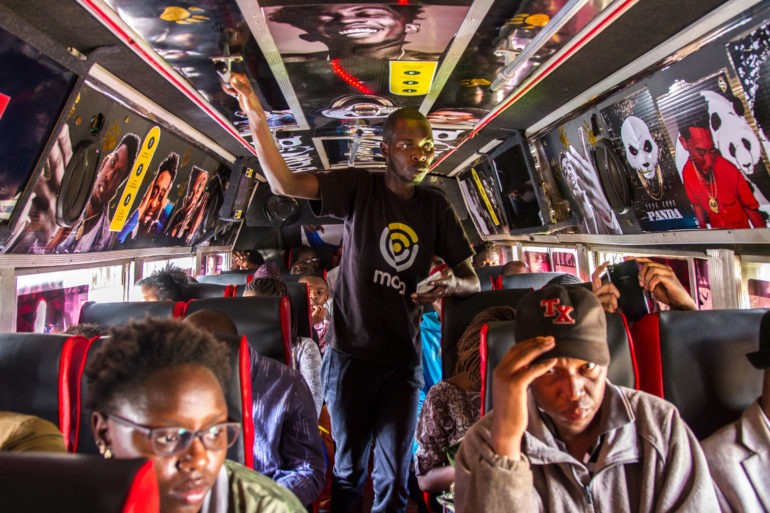
Today we’ve deployed 850 of the SupaBRCK’s running our Moja software into public transportation (buses and matatus) in Kenya and Rwanda. They’ve been quite successful with almost 1/4 million unique users monthly in just the first 3 months. We have both a tested and working technology platform, as well as product market fit. With unit economics that make sense, a growing user base, and a business model that works, we’re excited for the growth phase of the business. This next step means going nation-scale in each of these countries, and also determining our next market to enter.

It’s important that ordinary people across Africa and other frontier markets can stop thinking about the costs of the internet and don’t have to turn off their mobile internet on the smartphones that they already have in their pockets.
Once they know they can afford it, the way they used the internet changes dramatically. An Internet like this is feasible today, and it’s a cheaper, faster, more distributed and resilient one. It’s also being built from the ground up in Africa, where we’re close to both the technology and human problems, and have a better chance of building a the right thing.
Thoughts and Lessons Over 5 Years
First, make sure it’s a big enough problem.
If you’re going to spend 5+ years of your life on something, make sure it’s something that matters. At BRCK we are creating the onramp to the internet for anyone to connect to the internet, and a distribution platform for organizations trying to reach them. If we succeed we only succeed at scale, which by its nature means that we’ve done something big and that it has made a large impact on people.
Second, figure out what to focus on.
When you start out it’s difficult to determine product market fit. We started with a wide funnel of possibilities for our technology, industries that we could target and consumer plays. Over time, we were able to narrow down what could work, and what we could actually do, to the point where we focused on this big “connecting people” problem. We did detour into education with our Kio Kit, which we still think is one of the best (if not the best) holistic solutions for emerging market schools – after all, it’s in places across Africa, as well as the Pacific Islands and as far as Mexico. However, it proved to be too costly for our bottom line to hold inventory, sales cycles are too long, and it was largely a product sale. When we realized that, we started to focus most of our efforts on the bigger underlying issue across all of the markets, which was affordable connectivity and our Moja platform.
Third, persistence trumps skill.
building hardware is hard. It’s even harder doing it in Africa. The upside however is that you’re both closer to the problem, and that if you succeed in figuring it out, you have a good head start on everyone else. The process takes time, costs money, and there are people and organizations who don’t want you to succeed. It always takes longer than you want to get software working properly, or hardware built and reliable. We’ve often been faced by that same problem that plagues all venture backed companies in Africa, in that you have to do a lot of education to investors to even raise the capital, and then when you do you get charged a premium for perceived risk. Partner organizations take resources and time to work with, and they don’t always come through on their promises. All of these things (and more) mean that the best ideas don’t always win in the market, because it’s those that push the hardest and longest that win.
Fourth, it’s the people you do it with.
If you’re going to be on a journey that takes a great deal of time, with intense pressure, and where success is not guaranteed, then you had better do it with people that you can trust, who you can work with, and it helps if you like them too. Throughout my work career I’ve been more fortunate than most (whether at Ushahidi, iHub or BRCK), and this time is no exception. I get to work with a host of wonderful people; not just smart and talented, but also genuinely good human beings. It makes work a joyful challenge, not an exhausting chore.
So, to those back in the day who believed we could do this when it was just a sketch in my notebook, thank you Shuler, Kobia, Nat and Juliana (and the rest of the team at Ushahidi). To our investors who have joined us in this dream of connecting and doing hard things, you’ve continued to step up and that has made this possible. Thank you.
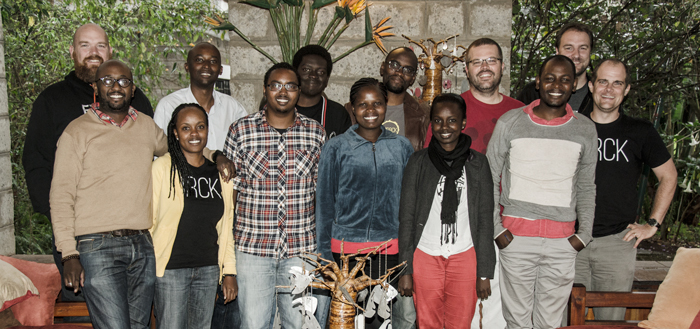
To Jeff, Janet, Birir, Kurt, Barre, and Oira, thank you for sticking it out for all these years and stepping up to more leadership challenges as we’ve evolved. To Philip, Reg, and Kala, I want to thank you for making the impossible happen, time and again, each for more than 5+ years.
]]>
Northern Kenya has always felt like it’s a different country, most Kenyans don’t seem to get north of Isiolo and it really is a forgotten place. This was made clear two years ago when we were on our Turkana Eclipse expedition and a man told us, “when you get to Kenya, tell them…”
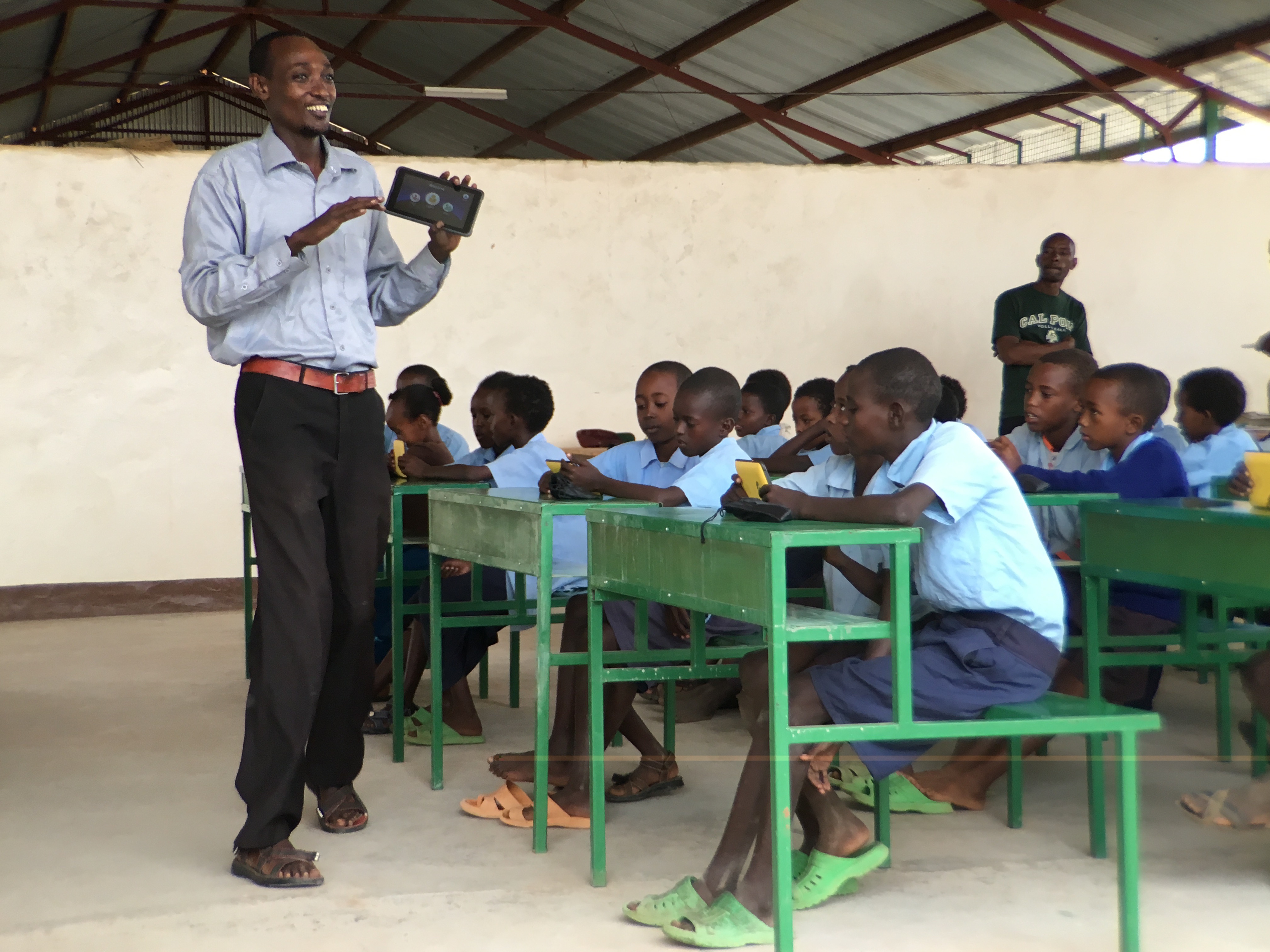
This week finds us up in Northern Kenya again with our education solution from BRCK, called the Kio Kit (video). We figured that if we were going to get some real value out of seeing how people use it, let’s go to somewhere far away that has a great deal of challenges, but also never gets anything tested there. Our “Made in Kenya” expedition takes us up to Samburu and Marsabit counties.
I’m no Jon Shuler, but I put together some of the images and short videos from our trip thus far since we had some dead-time yesterday evening.
BRCK: Made in Kenya Expedition 2015 from BRCK on Vimeo.
You can find stories from our trip on the BRCK blog below:
Day 1 – Samburu women and digital education
Day 2 – Digital Literacy on Kenya’s Frontier
Day 3 – Some things are different, but mostly we’re the same
Day 4 – Designing at the edge of the grid
Find more on Twitter @BRCKnet or find some of our images on Instagram @BRCKnet, you can also find more on my feed @White_African
Some shots from the trip thus far:

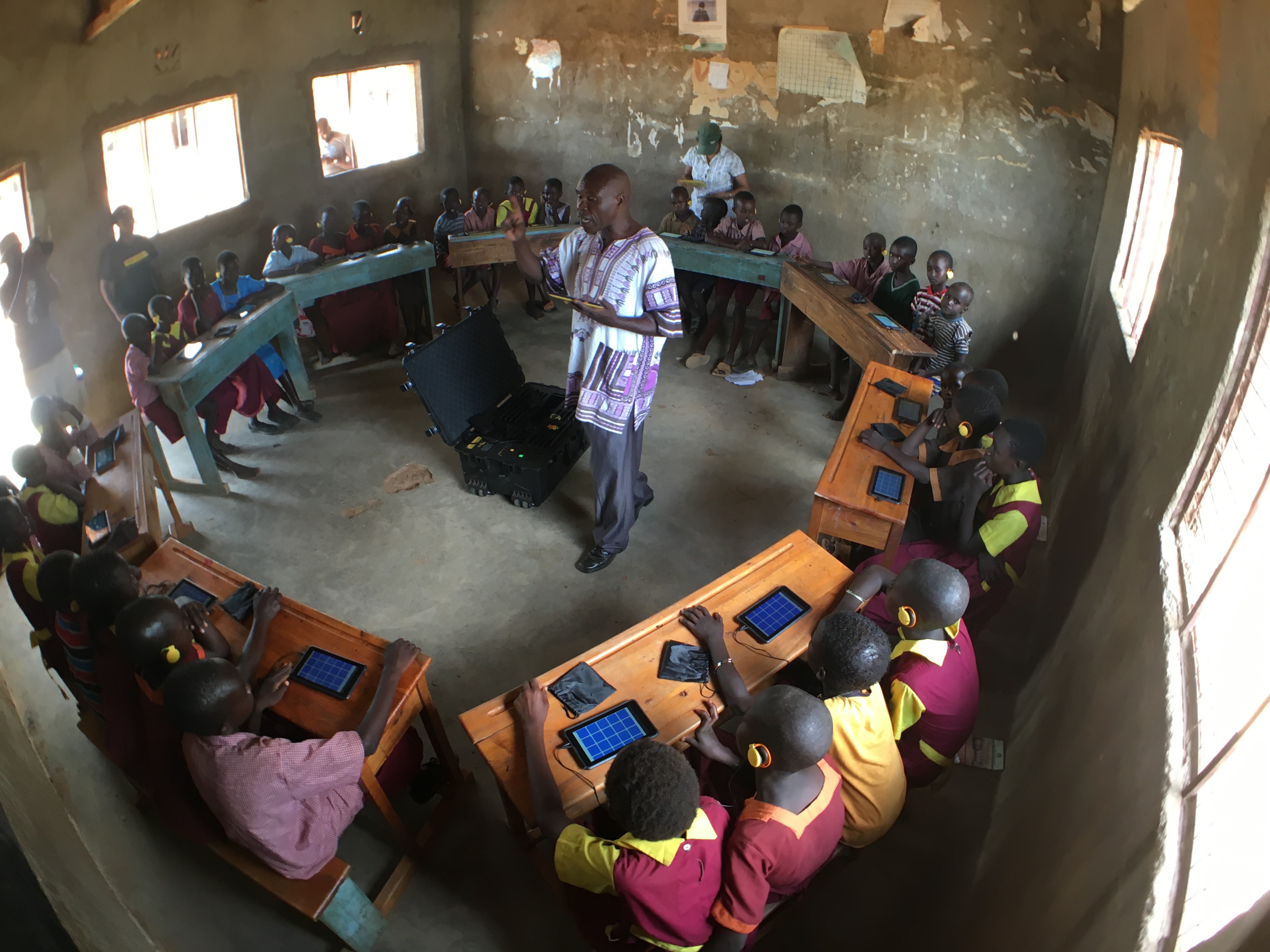
Using the Kio Kit in a Samburu classroom
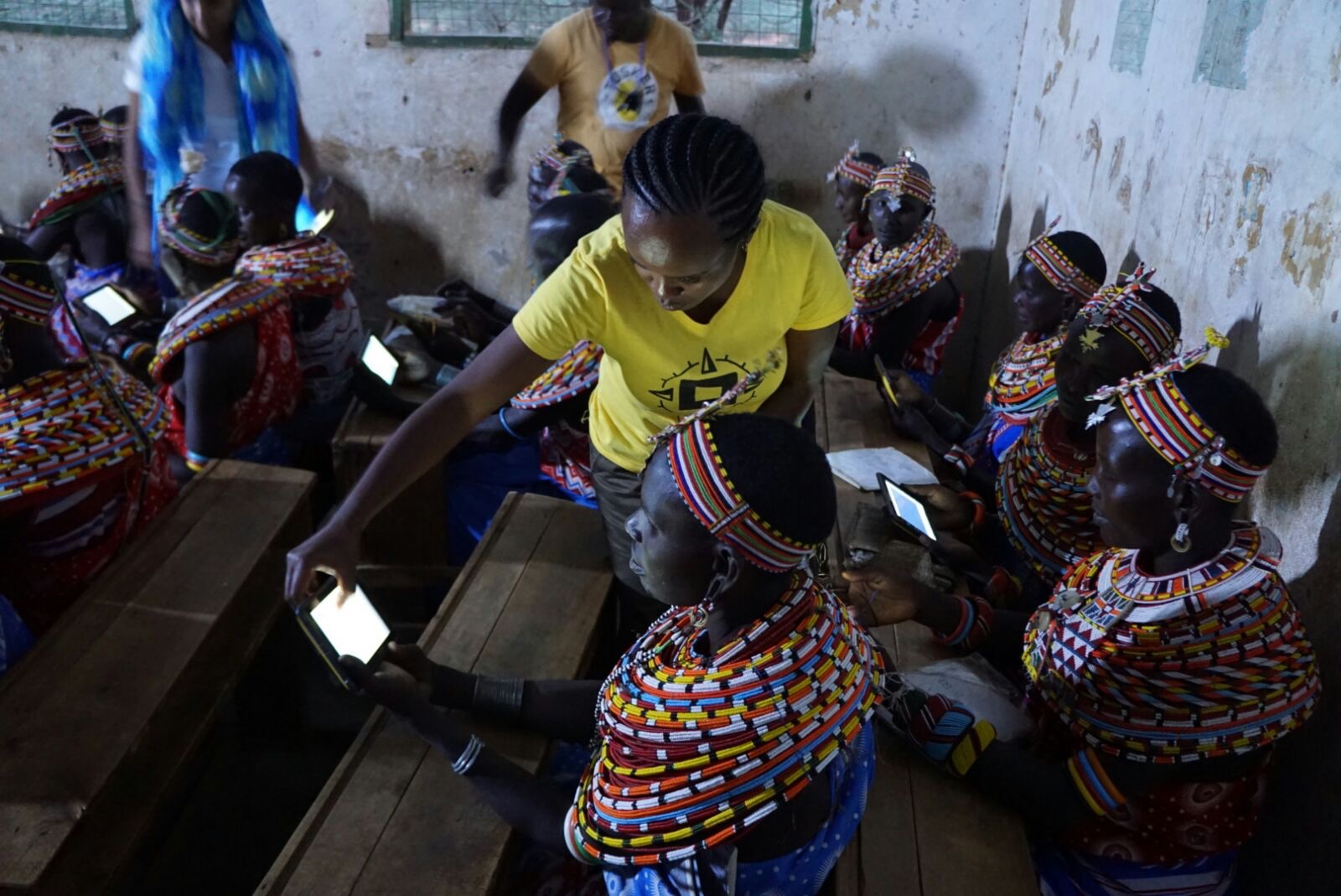
Janet helping some Samburu women use the Kio

That meta-narrative is, “white investors are abusing their money and privilege to push out black Kenyan founders of a company to steal it.” This is factually wrong and will have long-lasting negative repercussions if not corrected. The racial overtones alone demean us all. We’re better than this.
The real meta-narrative of this story is one of inexperienced management and the subsequent irresponsible behavior of startup founders, and how that reflects on the Nairobi tech ecosystem at large. It’s about growing pains and learning, and also about a community coming to terms with the need for more professionalism when scaling and growing companies. It’s about what independent board members and investors rights and responsibilities are.
To understand why these allegations are wrong it’s first helpful to understand what drives investors (from any country) and their actions.
On Investors
Tech investors are driven to invest in companies that can scale, gain market share and subsequently make profit. They look for great teams that have good ideas that they can execute on and pivot with as the business landscape changes around them over they years. Typically investors have financial interests in numerous companies at any given time, and depending on how much capital they’re injecting, they will take a seat on the board to represent their interests.
Because they have so many companies, the best case scenario is when a team is executing well and the investor has little need to be involved in anything but receive updates so he/she can help where asked. The worst case scenario is when you have to spend days or weeks working on a company and can’t give attention to the other dozen companies you’re supposed to be working with. In short, no one wants any drama.
That said, as an investor you’re also a significant shareholder and typically represent a number of other shareholders when you have a board seat. When you’re making decisions at board meetings, you’re doing so for these people as well, and your mandate is to find a way forward that increases that shareholder value.
So what happened?
Unfortunately, at Angani, an all too common story emerged of inexperienced founders (knowledgeable, but inexperienced in management) who couldn’t overcome personal differences in order to run a company, and had seen a decline in revenues over the preceding 3 months (37% in June, 17% in July and in August).
When you take a sizable investment your company isn’t the same anymore, if things get tough (as they often do at some point in a company’s life), then you’ll have others outside of the original founding team weighing in to solve issues with you. In this case, that’s what happened, and the independent board members did the job of oversight and governance. A number of viable options were proposed and considered, whether that be restructuring the company or changing executive positions, however two of the founders rejected any board recommended changes and opted instead, to leave the company instead and walk away.
Following this board decision was a period in which access to the company’s key infrastructure was supposed to be handed over. This didn’t happen, which precipitated even more issues that culminated in the platform failing and taking down client accounts. It was at this point when Angani issued a statement explaining the system failure.
This is far from the sensationally incorrect story of a hostile board takeover by investors. It’s an old story that can happen across any industry in any country.
Final Thoughts
Startups fail. Sometimes this is due to bad ideas, business or operating models, others to poor financial management, and some to founder disputes. This happens everywhere in the world and is unfortunately the norm for tech startups.
However, we can’t allow ourselves to change the dialog to something that it isn’t. This isn’t about race but instead the simple realities of how ugly and painful it is when a company goes through real management challenges. Nairobi has benefited from an openness to foreign talent and investment for many years – and it shows in the successes that have happened since. We should try to learn from this so that we don’t repeat these mistakes or, worse, that we develop a reputation as a petty and unprofessional investment market and further scare away foreign investments.
We’re one of the most dynamic and active tech communities on the continent, and because of this have high visibility to investors. Capital will not continue to flow to other startups in Kenya if investors believe that a gun can be held to their head on governance and oversight issues of their investments. There are other places that they can go where the community will be more investor friendly, and where they can fall back on the rule of law to protect themselves.
Our tech community is a work in progress, it takes all of us working together to make it better. We need to get this startup and growth stage of tech companies in Kenya right – we can do better, and we will.
]]>
Since 2010 there has been a massive influx of motorcycles into Kenya due to the reduction in duty on bikes under 200cc, and until 2013 there was an extra exemption on import duties for motorcycles completely assembled in-country. Tens of thousands of young men have taken to the courier and two-wheel taxi professions due to this.
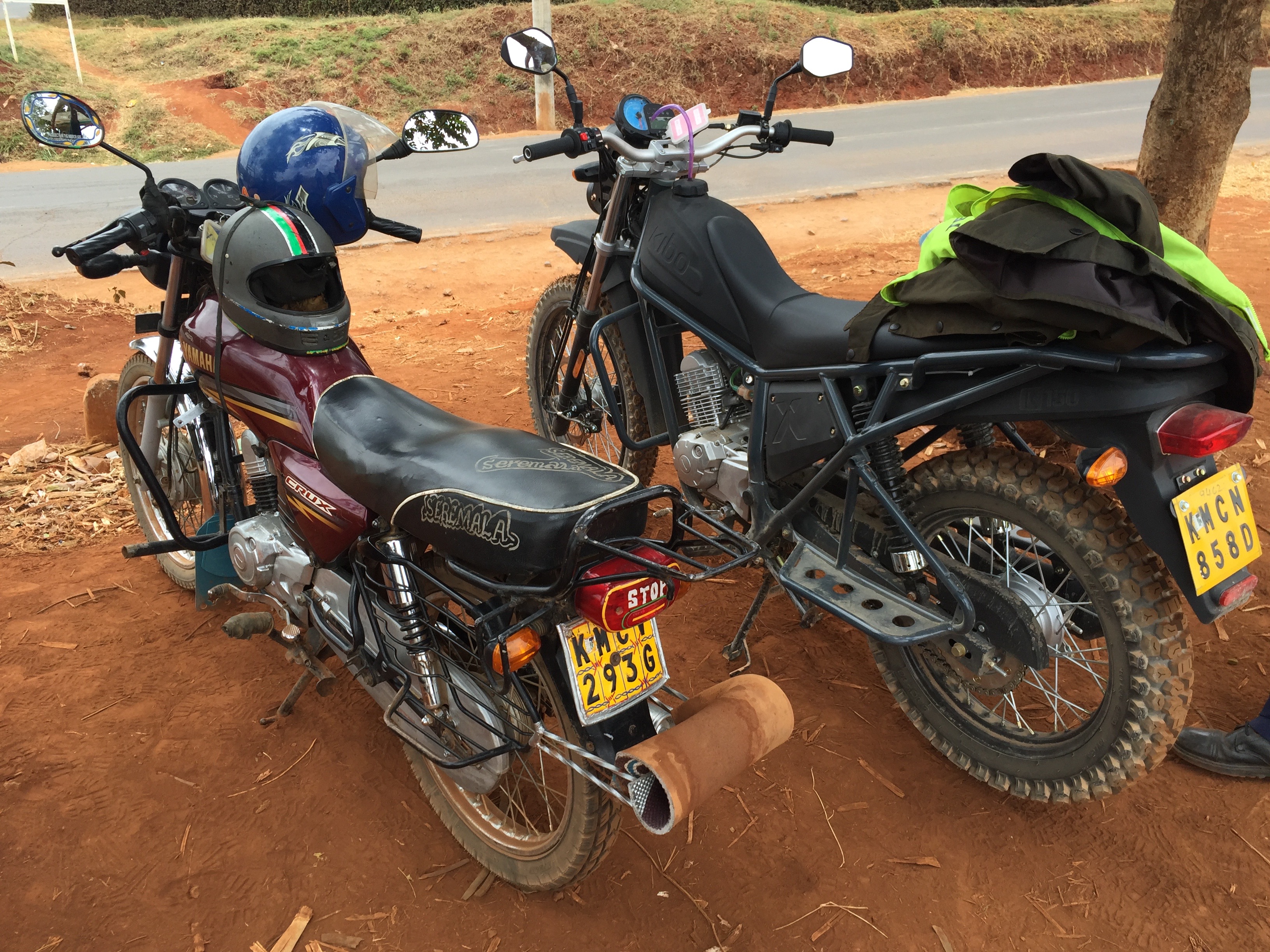
The staple of the boda boda (motorcycle taxi) drives is the cheap Chinese and Indian bikes usually around 100-150cc. The Bajaj or the TVS will sell for anywhere from 80,000 to 110,000 Ksh ($800-1,100), get approximately 40km/litre and carry a good 200 kilos. While not well designed or made, they do the job. Possibly as important as the pricing is the fact that you can get spares for them, and any tiny town worth its salt also has a piki piki mechanic in it.
Enter the Kibo
Henk Veldman is the Managing Director at Kibo Africa, and he’s part of the parent company Koneksie out of the Netherlands that came up with the idea to design and create a motorcycle for Africa. Their focus was for a bike that could be better and safer than the lower quality bikes that had been spreading across the continent, while at the same time making sure they were as good as the Japanese imports (Yamaha, Suzuki, Honda), while still being cheaper than them. It’s an interesting middle ground to choose, and the question the market will answer is if there is a customer base at that range.
A couple years ago they started to design what would become the Kibo motorcycle. Kibo is short for “kiboko” in Swahili, which means “hippo”. We saw this from the very beginning, as they used the iHub UX Lab to do some of their initial work with people – and they’ve done a lot of user studies as can be seen on this video.
“This was done in close cooperation with motorcycle experts and the local end-user. The motorcycle would have to be sturdy enough to deal with many hours of usage in addition to the poor, often unpaved road surface. At the same time, it would have to be affordable.”
“Our solution to the existing mobility problem in Kenya is a sturdy, safe and affordable motorcycle. We offer this motorcycle as part of a complete package, consisting of financing, training, a maintenance program and insurance.”
Basic information on the Kibo 150cc (K150):
Price: 395,000ksh ($4,000)
Includes: Insurance, advanced rider training, maintenance
Engine size: 150cc (made in Japan)
Fuel economy: 42 kilometres per litre
Weight loading: 250 kilos
Taking it out for a ride, talking to boda boda guys
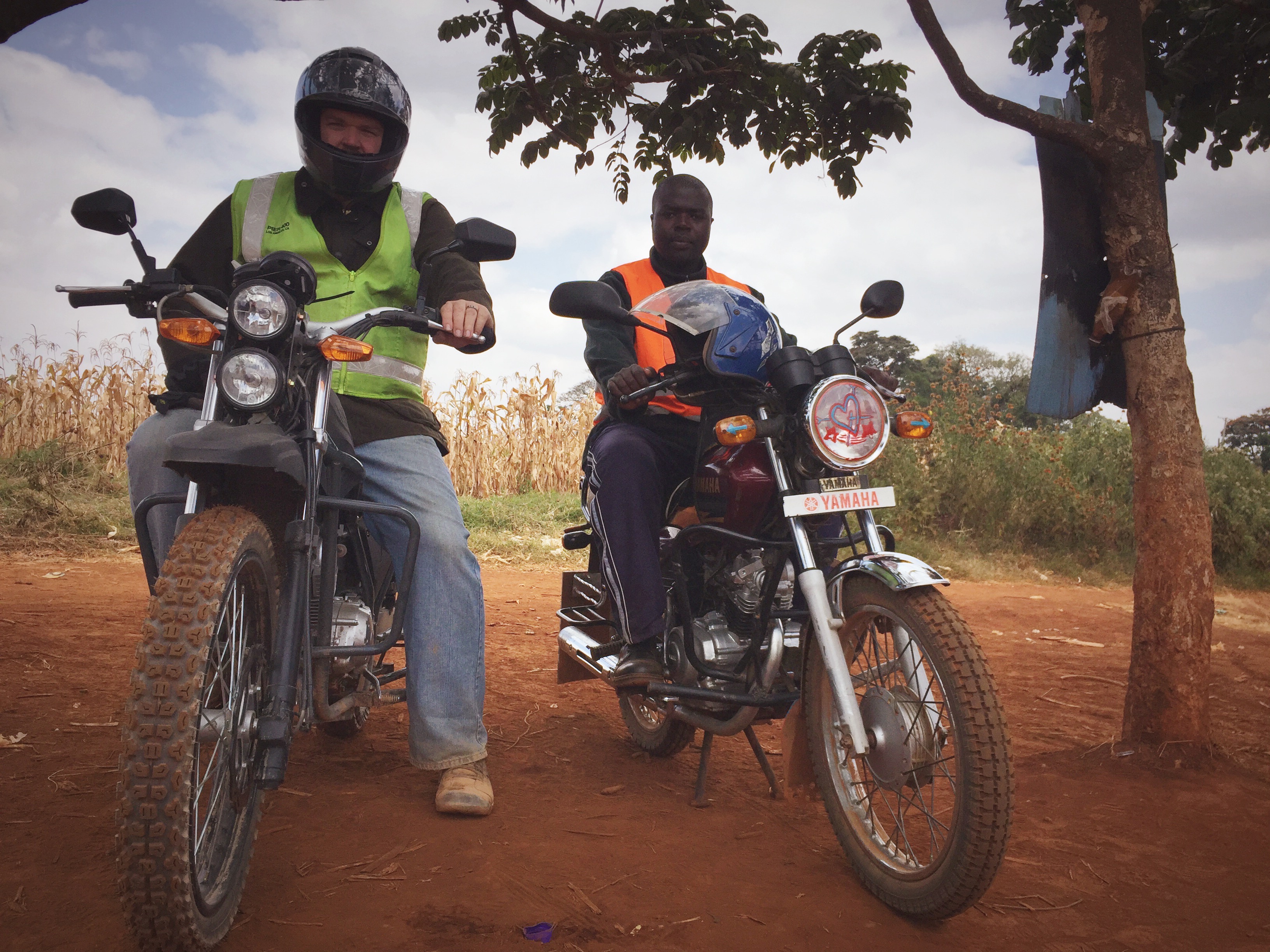
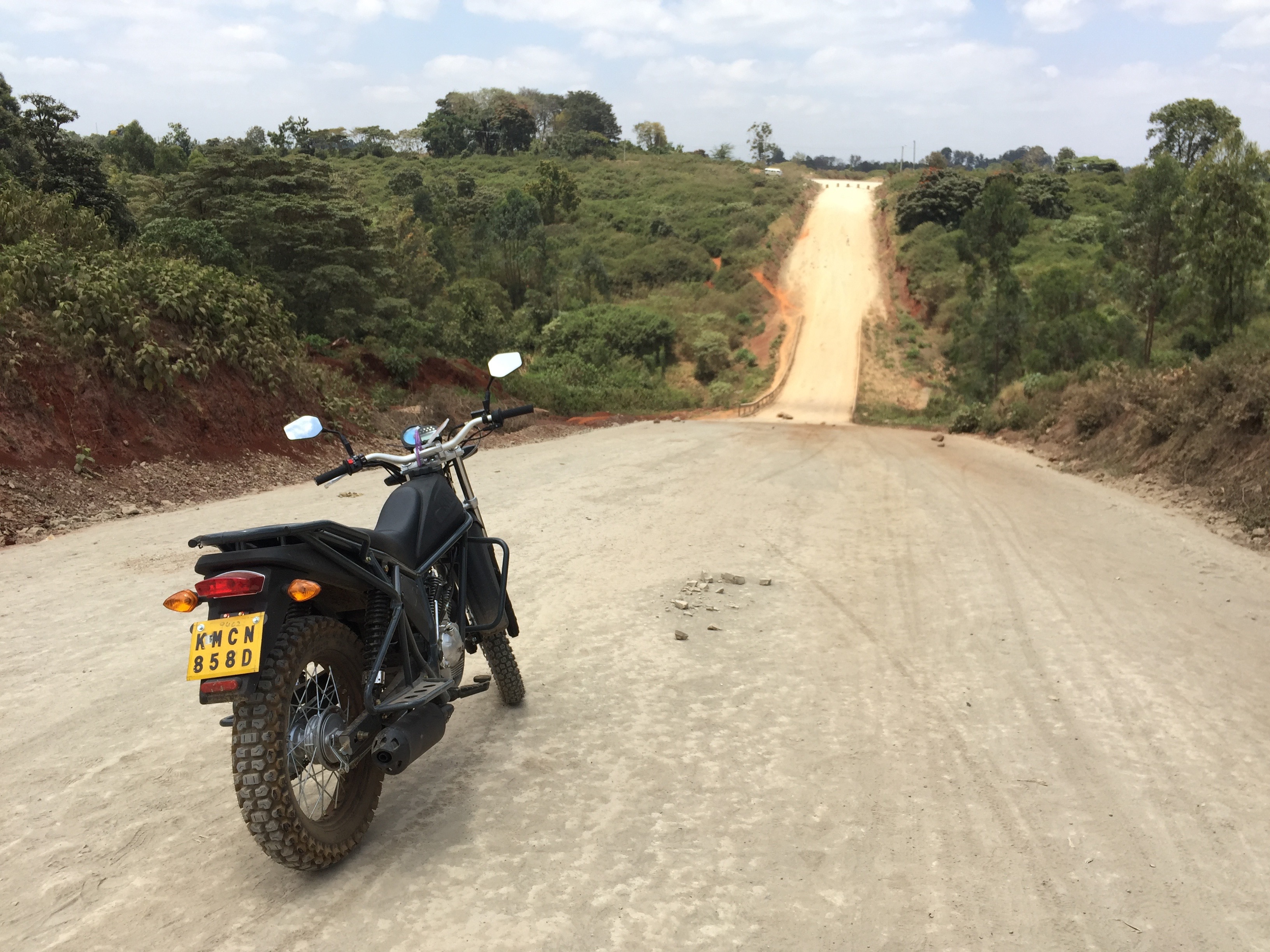
Henk and team were kind enough to let me take out one of the prototypes this weekend. I spent time stopping and talking to a lot of boda boda drivers as well as taking it seeing how fast it went on tarmac and then how it handled on dirt roads.
First impressions
My daily rider is a Suzuki DR 650, so it’s hard to get used to something so small. However, it’s really not that small – it’s a much larger 150cc frame and bike than almost any other I’ve been on.
It rides smooth. Balance is great. Little vibration.
Since it has 5 gears, on a wide open road I was able to get it to 110km/hr. On a windy road past Gachie, I found it handled well on corners.
I took it on a few dirt roads. The ones that had been recently graded were fine, due to the nice tires, I could move quickly and had great traction. On the really rough dirt roads, I was surprised at how well the suspension handled the ruts and potholes. It really did do a good job and handled well.
My only beef on the test drive was being on one very steep hill, with big ruts and deep powder. After I slowed down, the bike just didn’t have the power to take me up and I had to help it out with my feet. Now, I’m not a small guy, but I certainly am not anywhere near the 250 kilo weigh limit of the bike either. I’m checking with Henk, but I might have gotten one of the bikes geared for Nairobi (high), and not for rural areas (low).
Talking to Boda Boda Guys
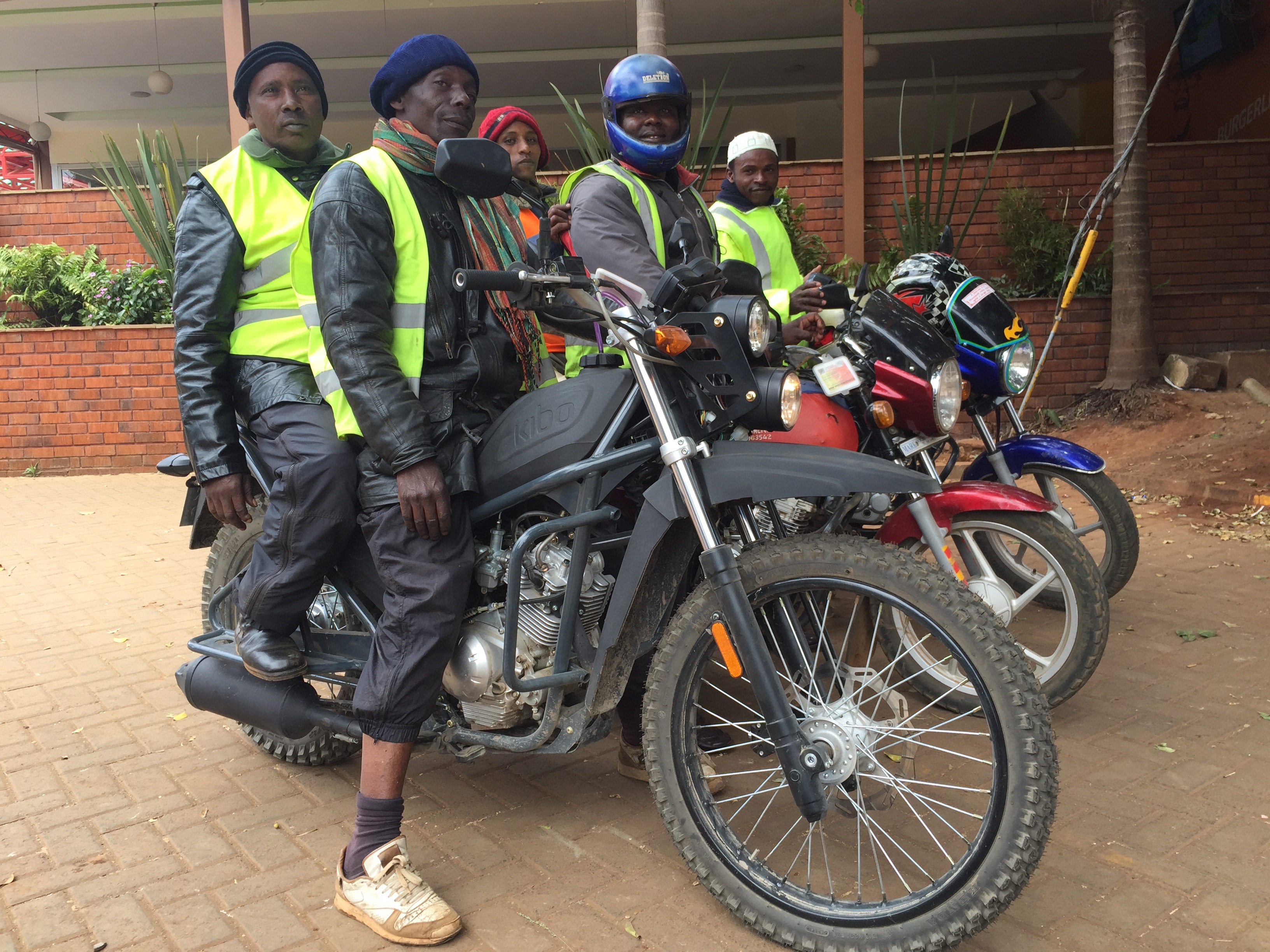
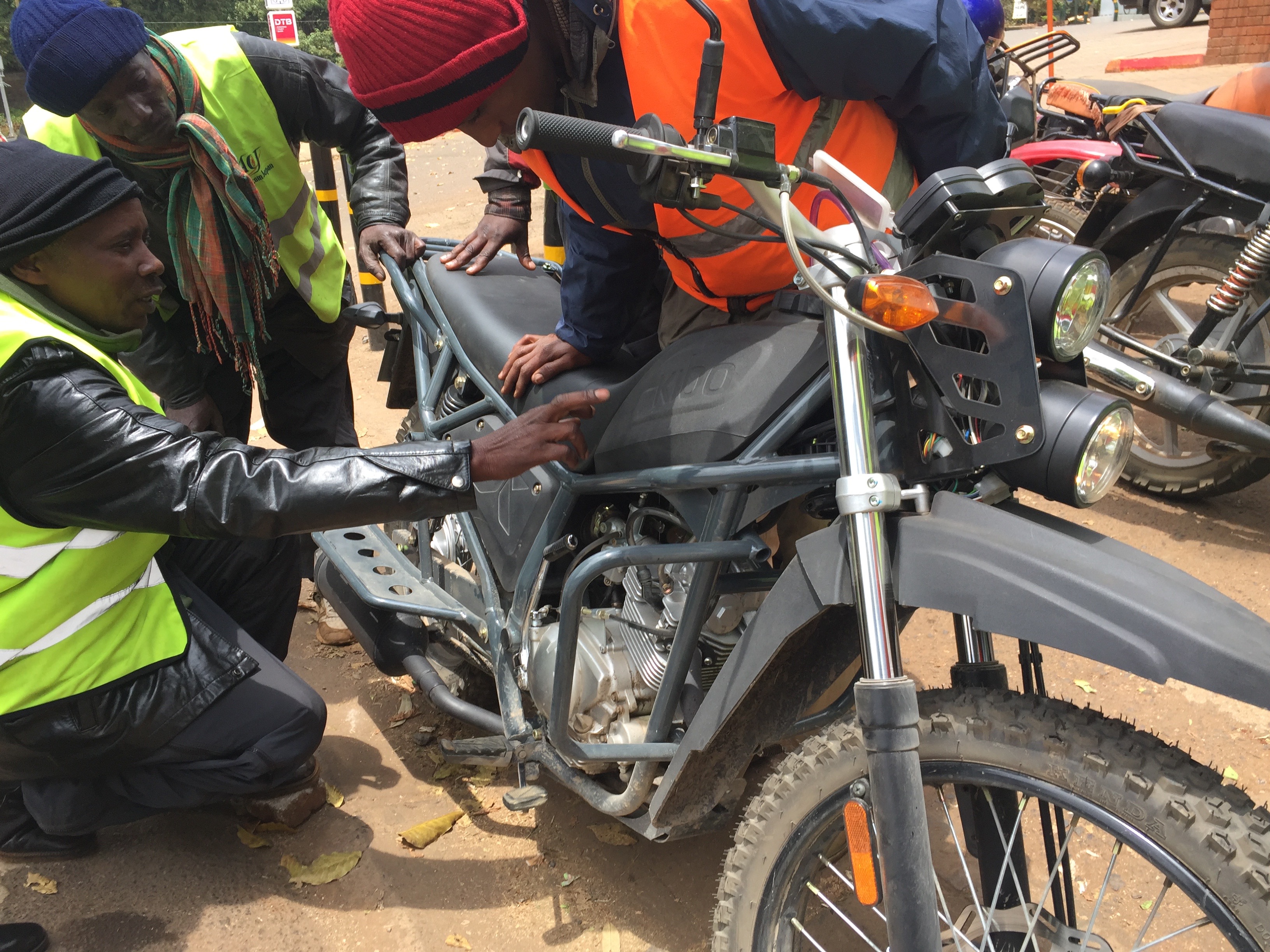
As I mentioned earlier, I stopped and talked to over a dozen motorcycle taxi riders and a courier to see what they thought of the bike. I let four of them take the bike out for a spin as well.
Before they left, they were all a bit leery, mostly due to the price. Once they got back, they were excited about how smooth and nice it was compared to their bike, exclaiming “Iko sawa, iko poa” (“it’s good, it’s cool”) to their counterparts.

Boda Boda riders pose on the new Kibo K150
Likes:
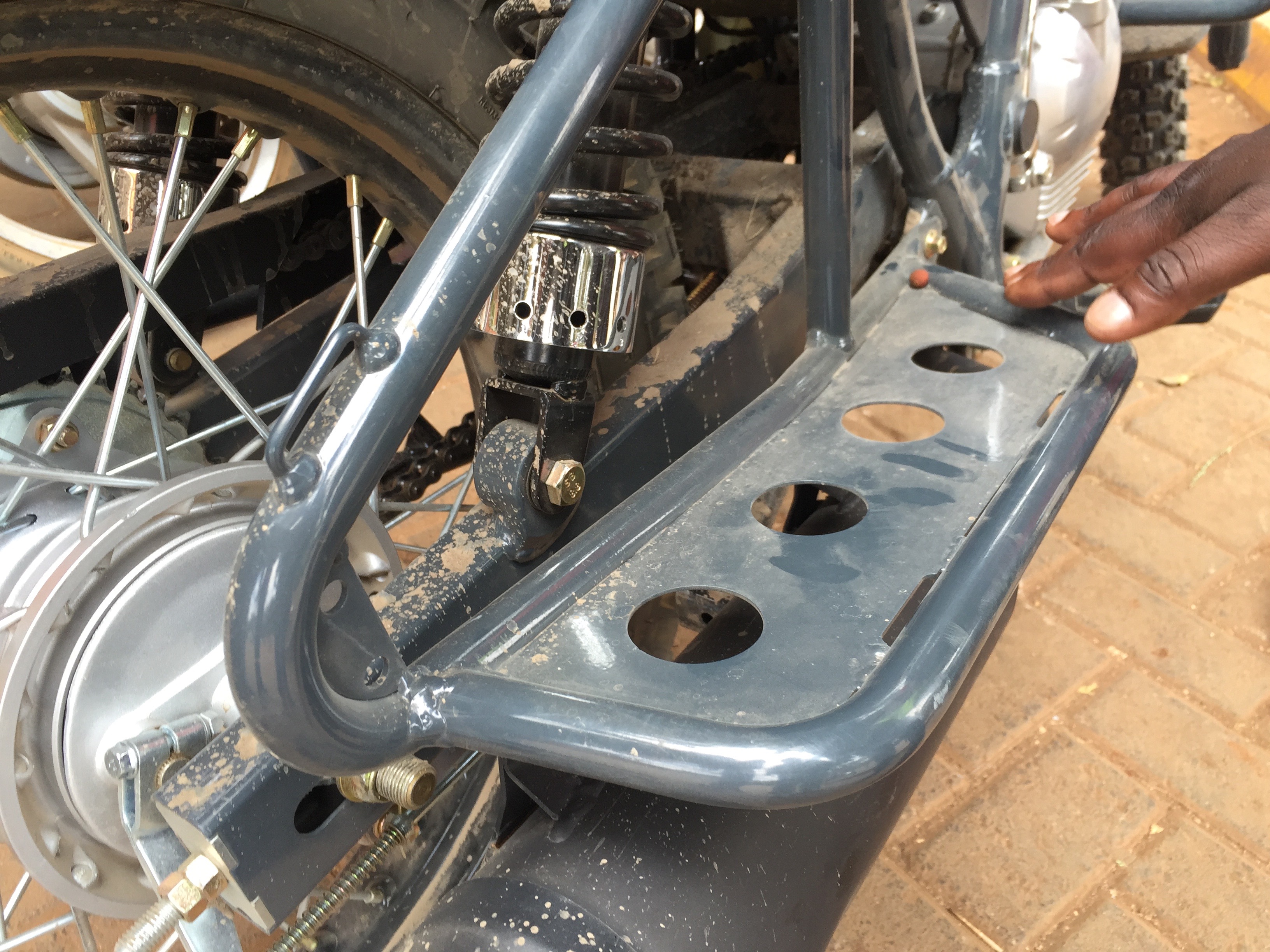
- Sturdy frame was greatly appreciated by everyone, for carrying loads and for laying it over
- The double lights were a big hit
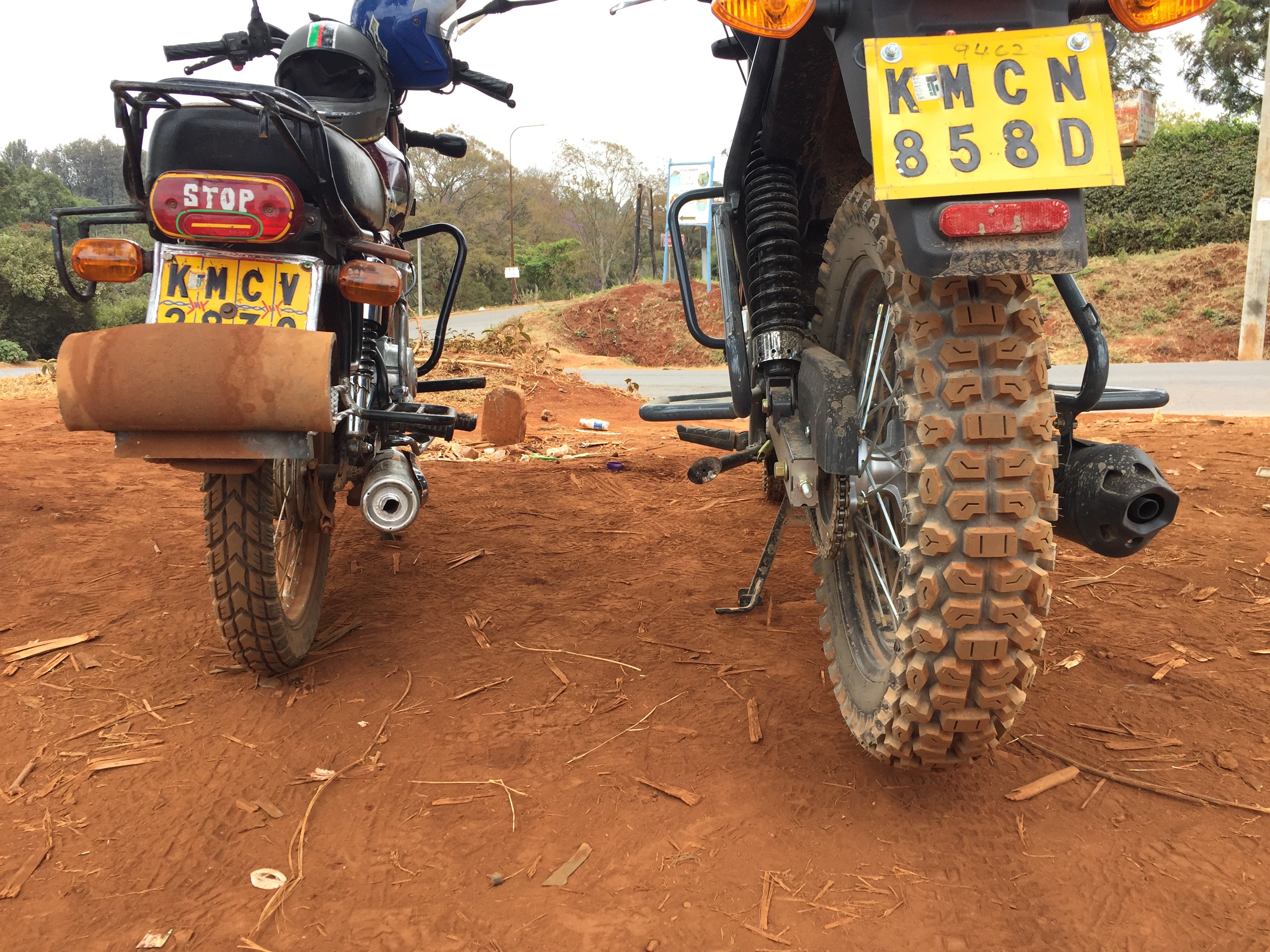
- Tires are strong and will do well on rough roads
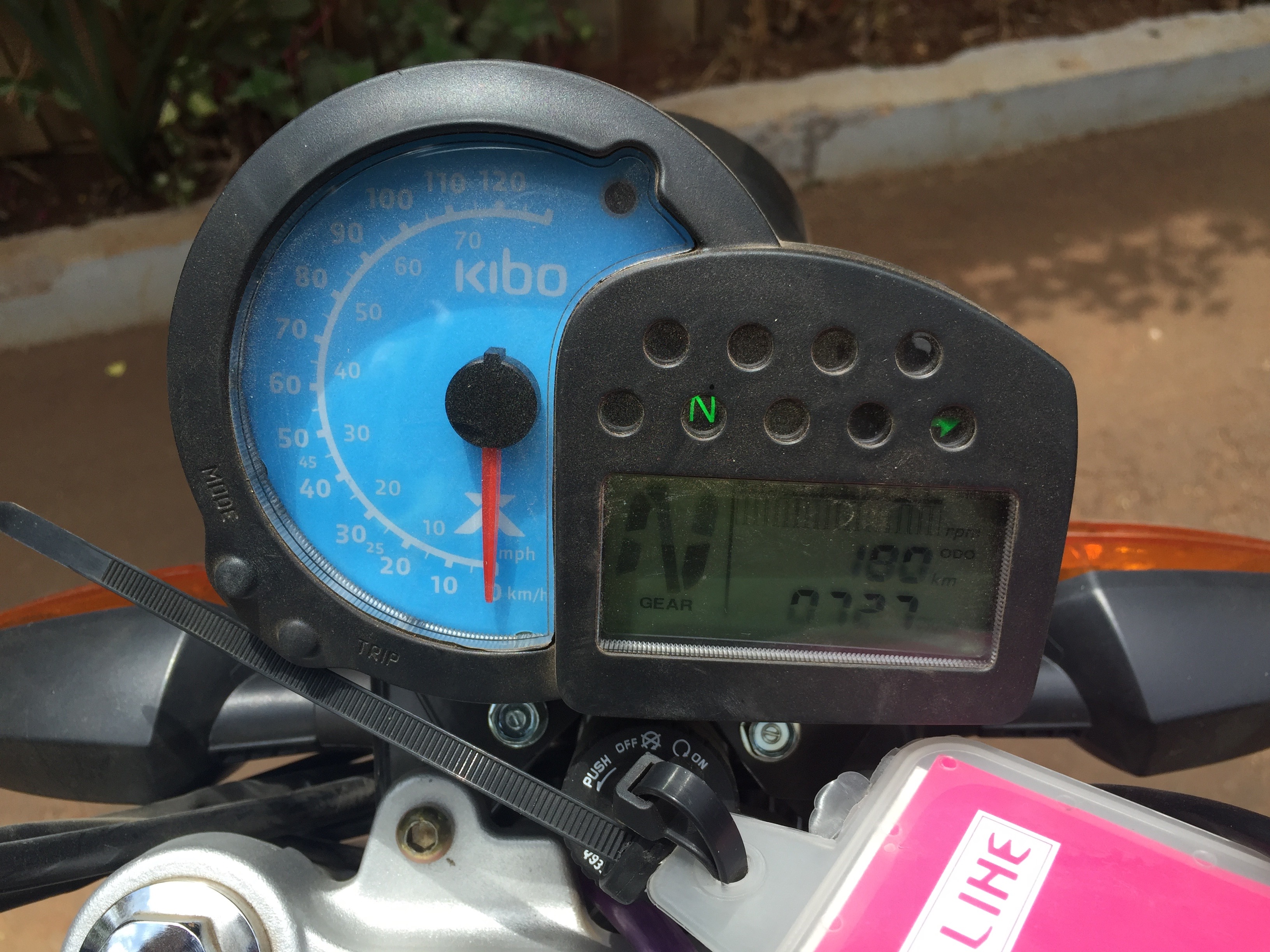
- Digital display
- Suspension
Requests:
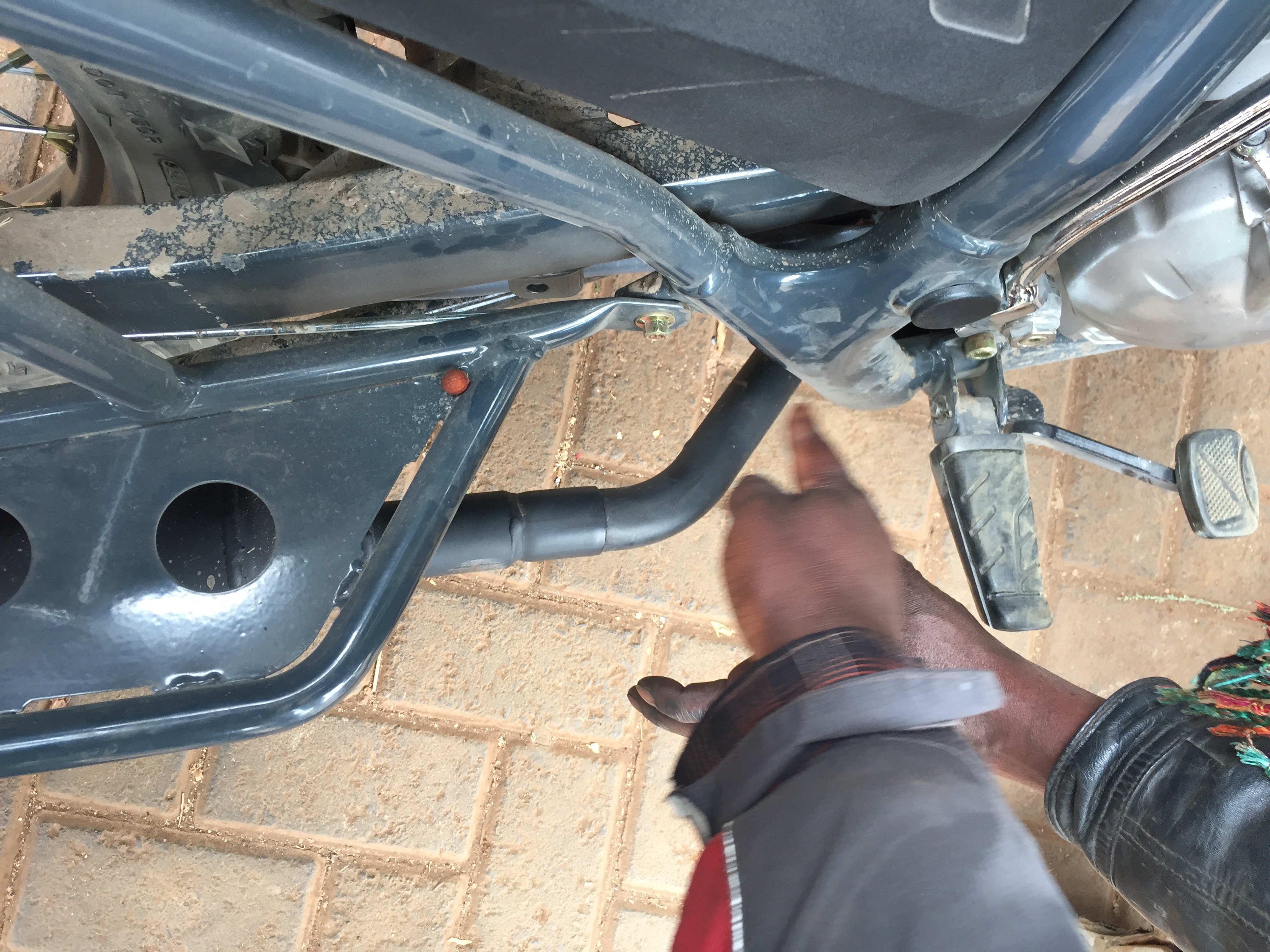
- Passenger footrest needs rubber due to vibration
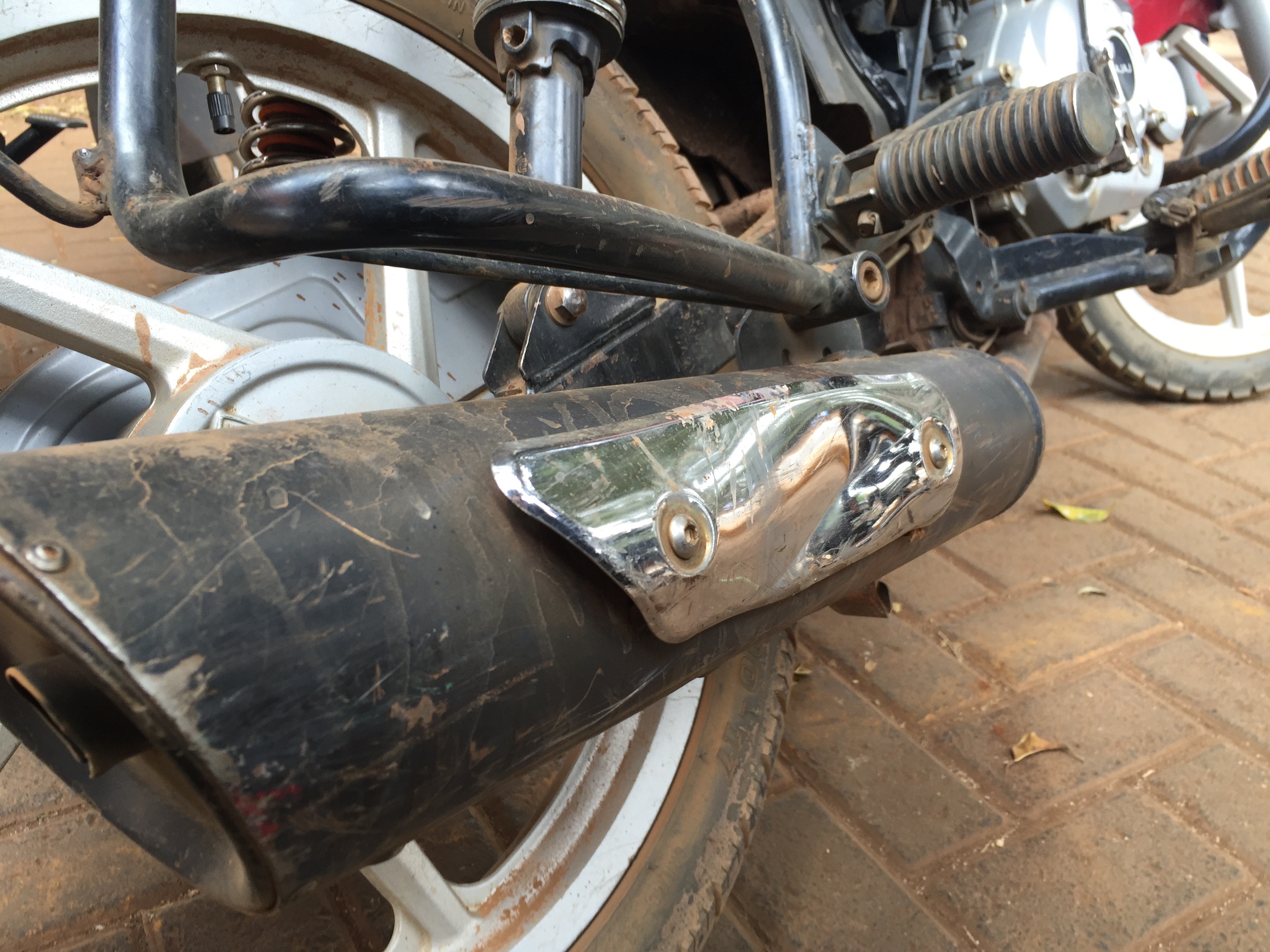
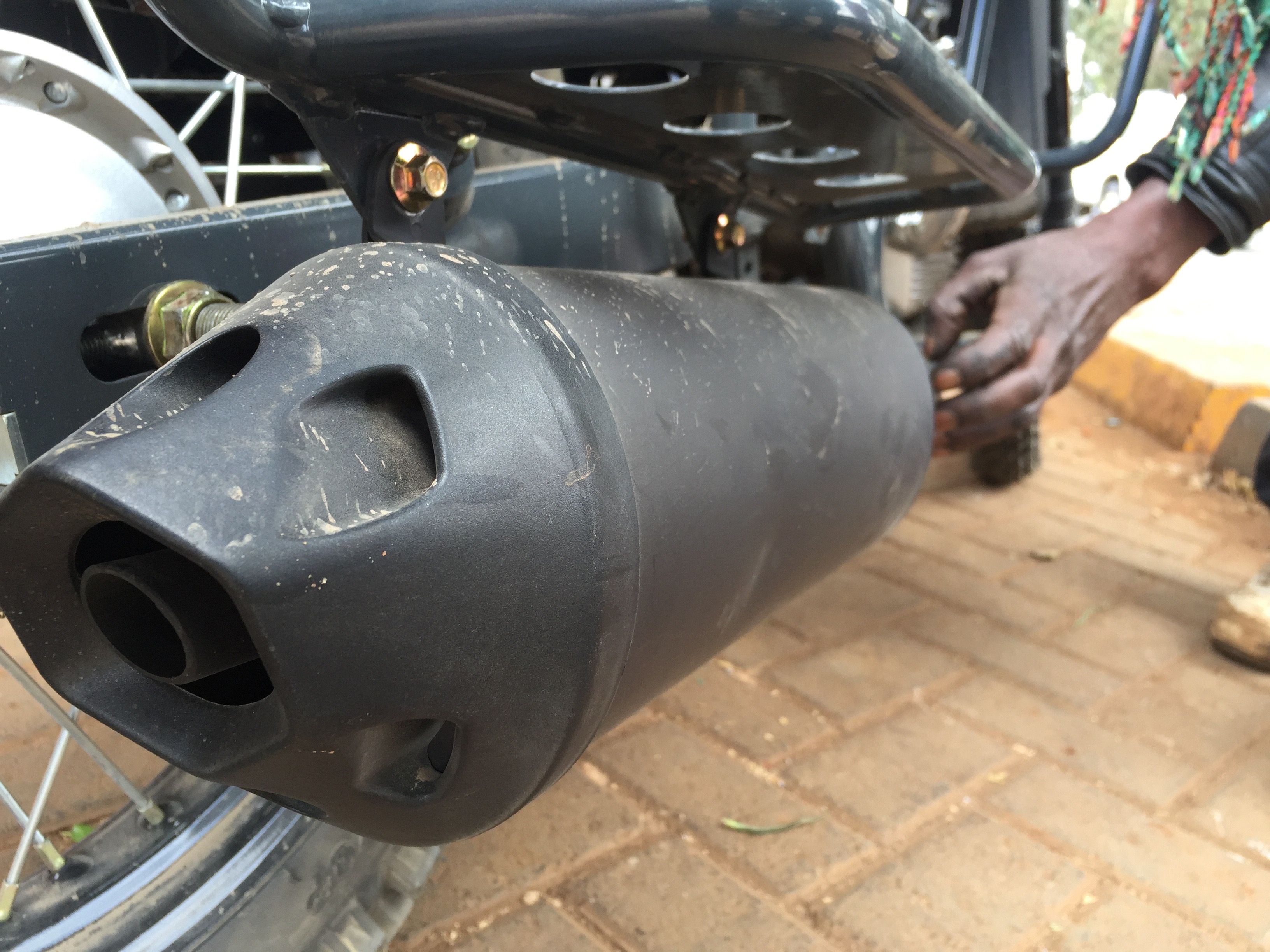
- Move the muffler mid-pipe inwards so the driver doesn’t burn their leg
- A windshield or fairing
- Tires are too big and expensive (10,000ksh [$100] as opposed to the 3,000ksh [$30] normally spent)
- A larger tank would be nice
- It’s too expensive, no one sees this as something that they could buy individually, it’s only good for businesses.
Final Thoughts
Overall I like the Kibo K150, enough that BRCK will purchase one to see if we can use it for delivery into some hard-to-reach schools for our Kio Kit. I’d like to see it geared for a bit more power (though again, it might have been the test unit I had was geared for city).
The price seems to be an issue. Individual motorcycle riders will have a hard time affording it, so as far as I can tell it will largely be purchased by companies. I like that Kibo is bundling the rider training, insurance and maintenance with the price.
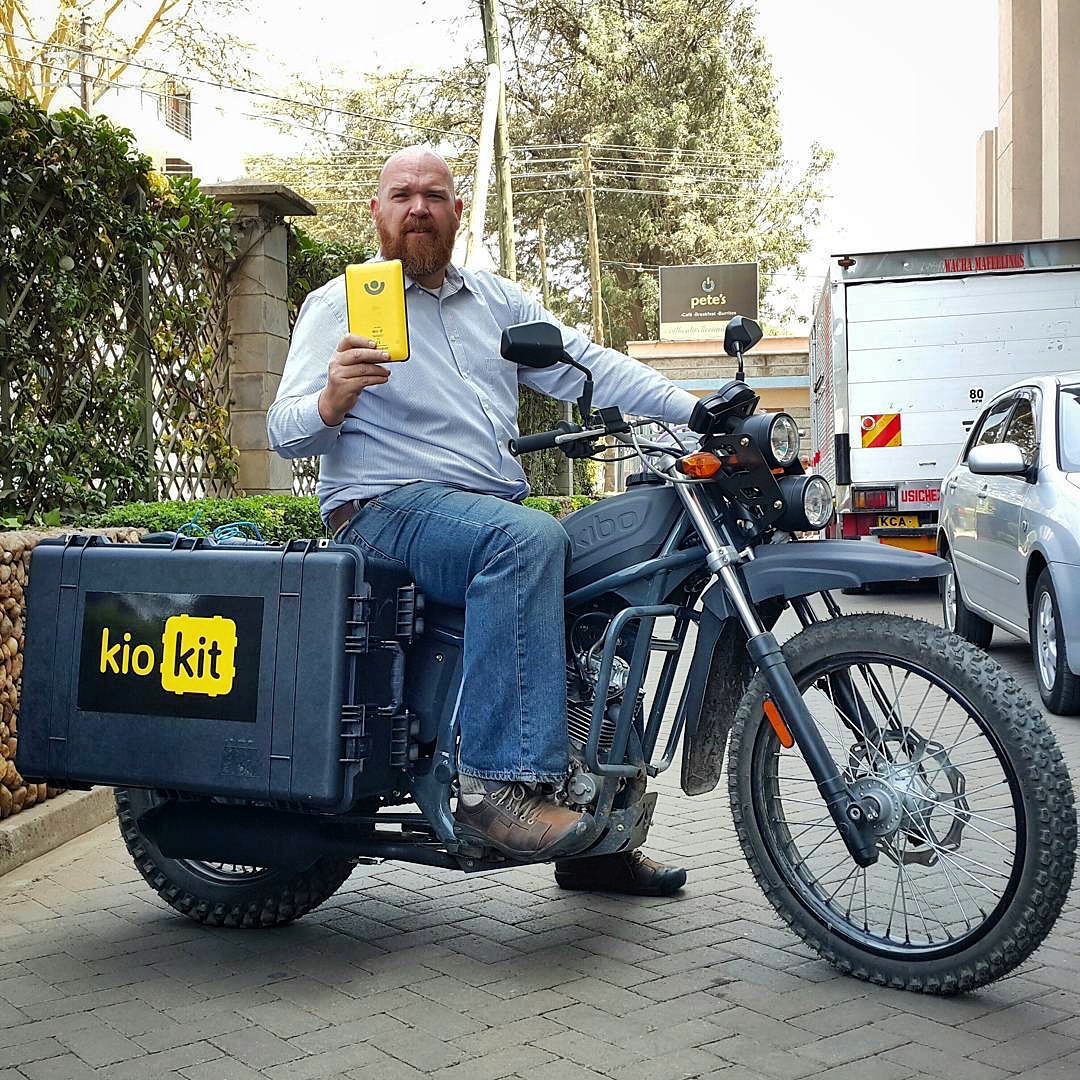
Testing the load of the Kibo K150 with the Kio Kits designed for schools in Africa
National Geographic photographer Ciril Jazbec was in town capturing the tech entrepreneur feel of Nairobi and surrounds.
I’m about a week late on my post, but thought I’d round up some of the news from the crazy week that ended with the Global Entrepreneurship Summit (GES) in Nairobi. With US President Barrack Obama in town, bringing some of the biggest names in tech and business with him, it was bound to be a circus.
We embraced the madness at the iHub and there were a great many events.
- List of tech events
- Pivot East (our big startup pitching event for East Africa) winners were announced (more here), and it was made into a TV show by DSTV.
- A blog post by Josiah Mugambi on GES before it all kicked off

One of the highlights for the week was seeing our very own Judith Owigar, co-founder of Akirachix and long-time iHub member, up on stage seated between President’s Uhuru and Obama on the main GES stage.
Big things that happened:
Bloomberg came by and did a photo walkthrough of the iHub, featuring Ushahidi and BRCK as well.
There was a good piece in TIME magazine about Obama’s visit and BRCK’s work around education, titled, “Obama Sees Kenya as a Hotbed of Innovation — Not Terror”
A timely piece on TechCrunch titled, “The Rise Of Silicon Savannah And Africa’s Tech Movement” came out.
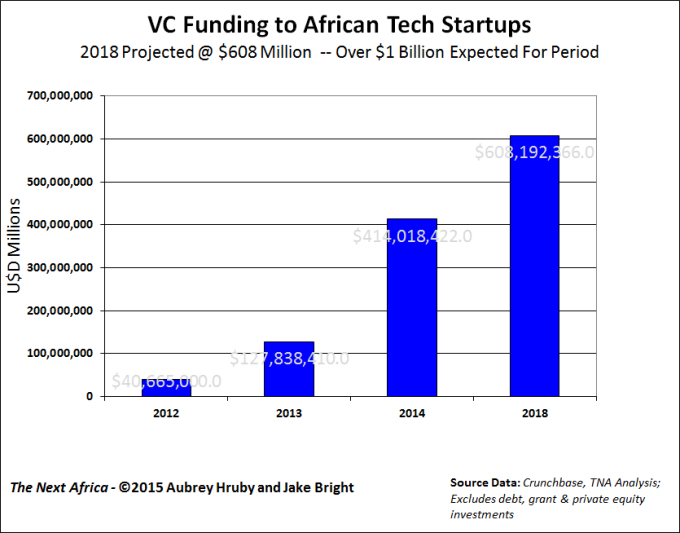
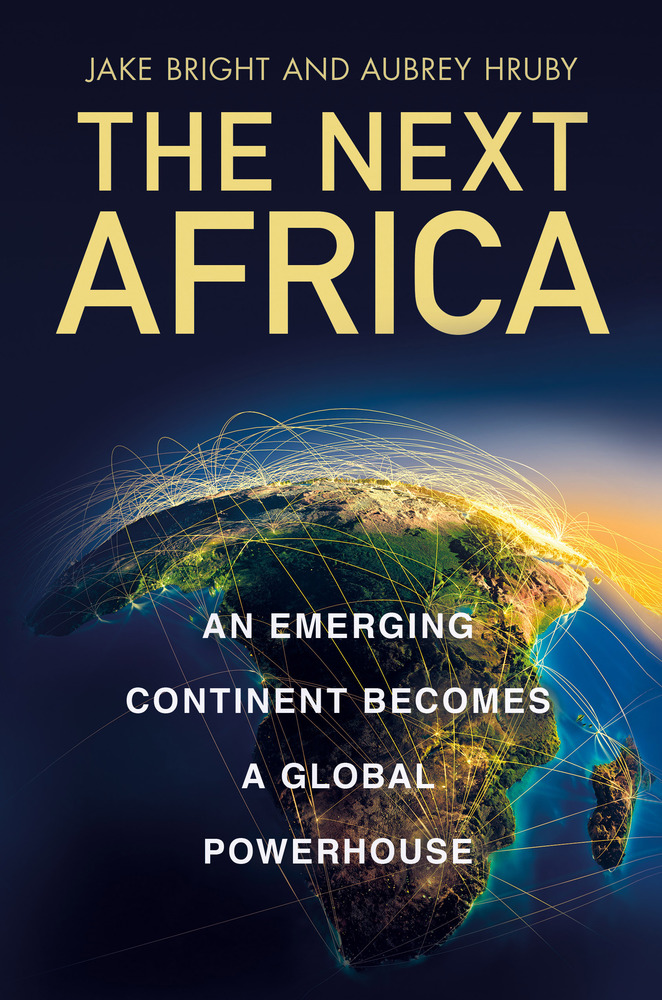 The Next Africa book launched, written by Aubrey Hruby and Jake Bright, we had a session at the iHub to talk through it with some of the subjects, like Just A Band, Dr. Bitange Ndemo and IBM.
We did a Fireside Chat with Brian Chesky, co-founder and CEO of AirBnB, that was one of the best we’ve had.
A piece in Forbes, “Why Kenyan Tech Entrepreneurs Deserve All Obama’s Praise“.
IBM partnered with the iHub to launch the innovation @ iHub space, so we’ll be working a lot closer with them going forward and that means members of the iHub community will get a lot more access to IBM, its partners and its resources.
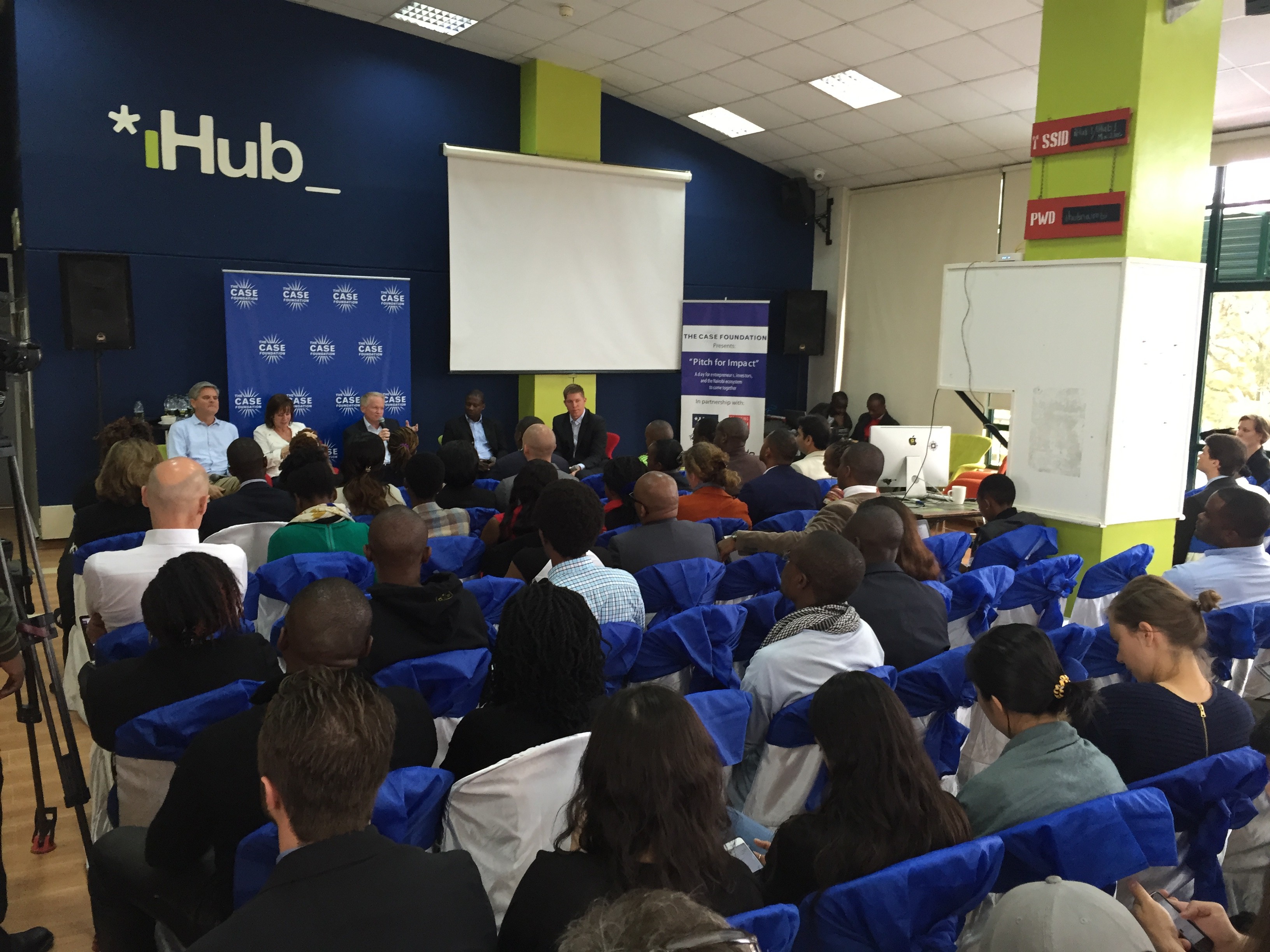
Jean and Steve Case, AOL Founders and investors, came to the iHub and ran a social impact tech pitching competition. They brought with them other investors, including Jim Sorenson, and Nina Tellegen CEO of the DOEN Foundation. Here’s Jean’s writeup on the week.
Finally, the US Gov’t made a lot of commitments to African entrepreneurs.
While it was a big week, and it served to remind us how far we’ve come and a chance to celebrate it with the world, we still have a long way to go.
BRCK: Also designed in Kenya and made in the USA. We had a little fun at BRCK with the Obama activity… 
Celebrating the Community – iHub’s 5 Year Tech Bash
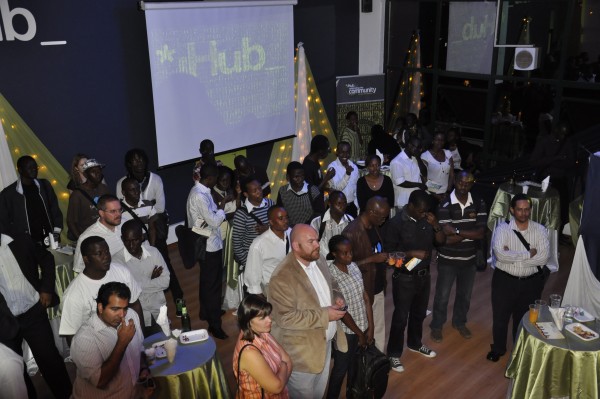
43 companies in the Kenyan tech scene have come together to put on an event for 3,000+ people in the tech community, the #5yrTechBash at the Arboretum. The iHub is turning 5 and it’s a testament to the people and companies who make up this space that we’re thriving and have a chance to celebrate.
It’s a community event by all of us, for all of us!

Community as our Legacy
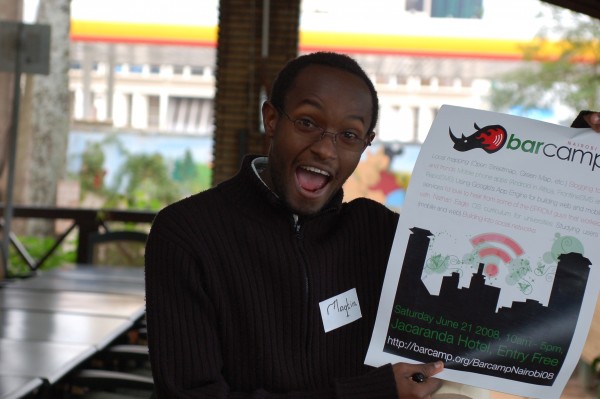
There has been a long history of the tech community in Kenya coming together, from Skunkworks and Barcamps to the iHub itself. I tend to think of community connectedness as one of Kenya’s key competitive advantages. Read this blog post by the founders of Angani, a company made up of some of the pioneers in the space, to understand some of the background on how this has come together.
If you read this post I wrote on “What makes the iHub Work” from 4 years ago, you’ll see that it’s a combination of many people that ultimately makes it different and why it still makes such an impact on people’s lives. Also take a moment to read Josiah Mugambi’s piece on the last 5 years.

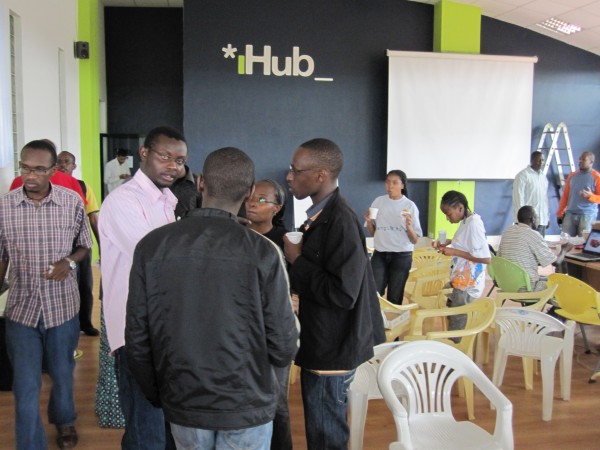
The iHub community over 5 years
Tracking the Numbers
One of the great strengths of the iHub is the serendipity that you have by coming in and running into people. However, that’s an inherently difficult thing to measure. I wrote a blog post 1.5 years ago about “what has the iHub done“, and it’s time for an update.
If you’re a place like the iHub with your own Research arm, then you measure other things, this from Leo Mutuku and the team at iHub Research:
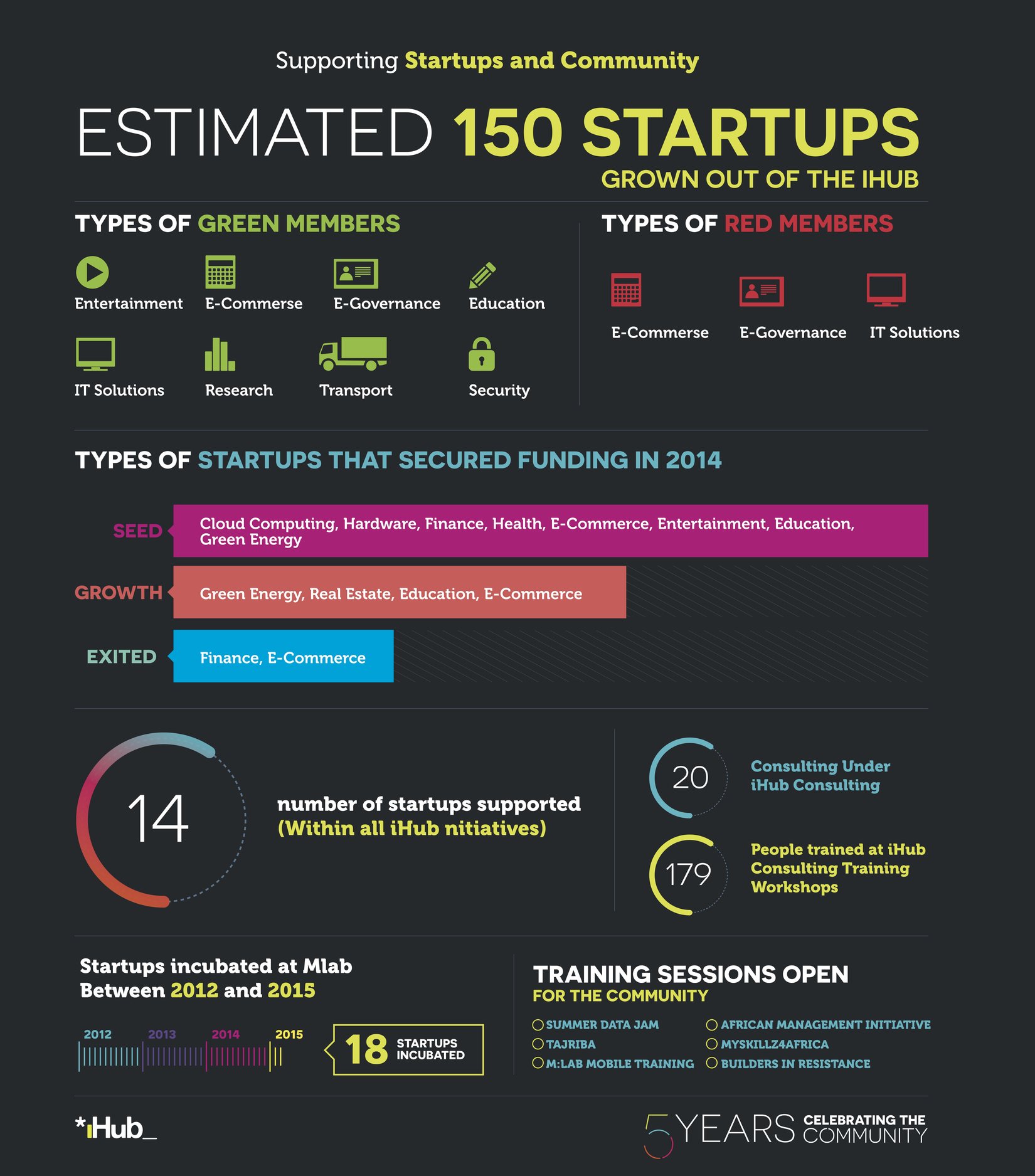
iHub Startup Numbers over 5 years
In the second year of the iHub, we started the iHub Research arm and the m:lab, both of which have excelled. iHub Research’s job is to shares stories about the vibrant East African technology community by conducting ICT research on technology innovation within the community. Here’s what they’ve done:
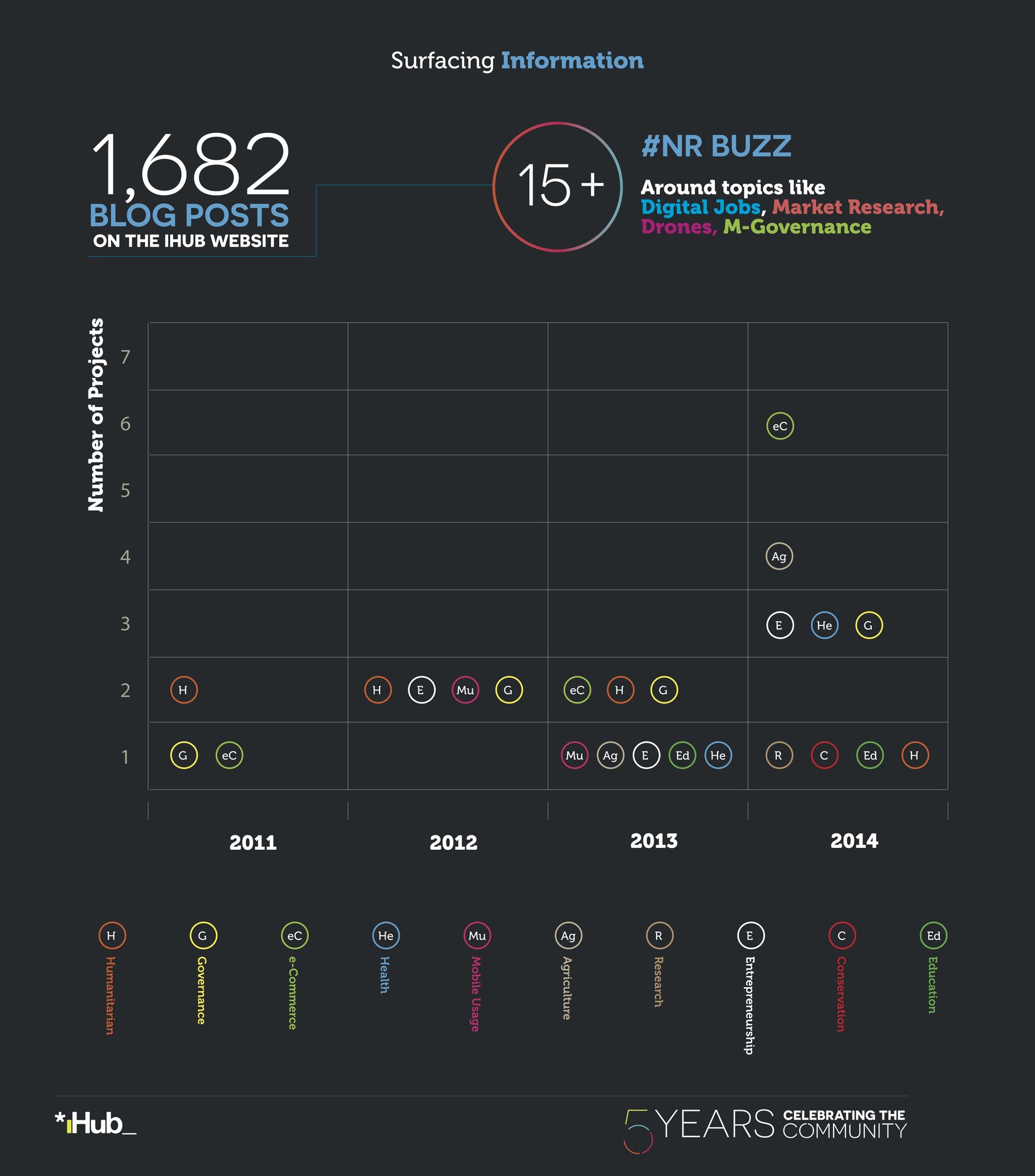
iHub Research over 5 years
To the next 5!
As much as the big bash today is a celebration of the past 5+ years, it’s also a time to get ready for the NEXT 5 years. While we’ve made a lot of progress as a whole, we’ve gotten much further than many thought we could in this time, we still have a long way to go.
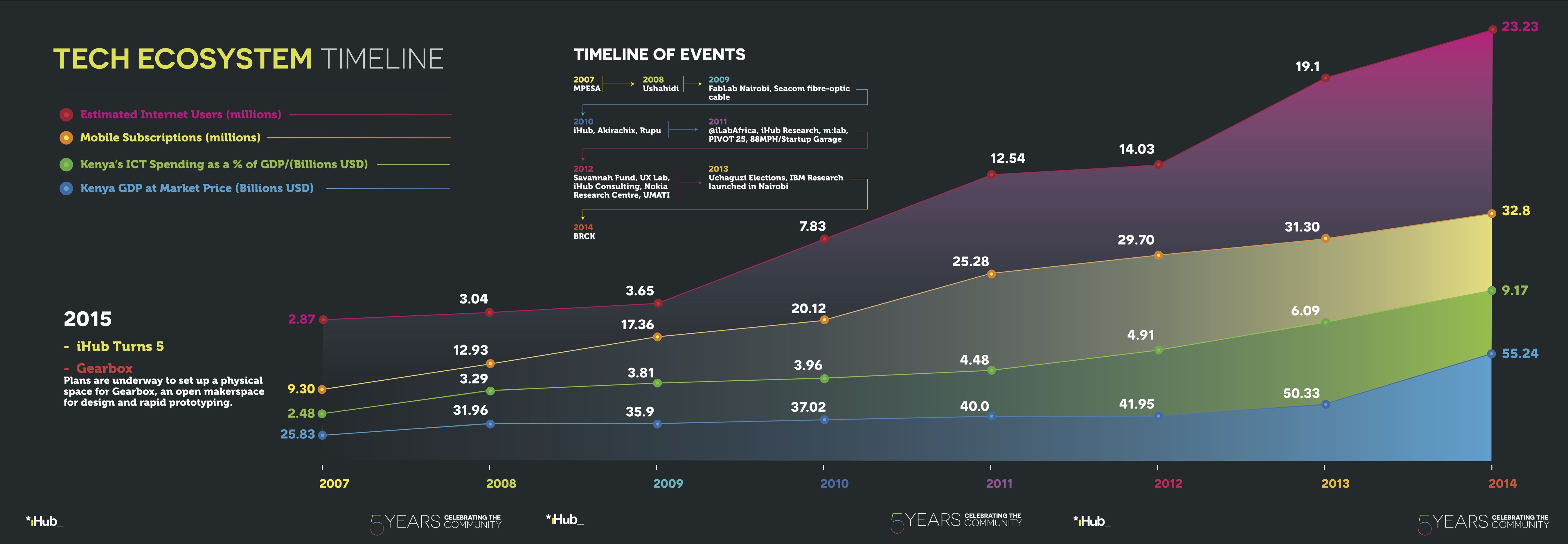
A timeline of events in Tech in Kenya over 5 years
A Gallery of Pics
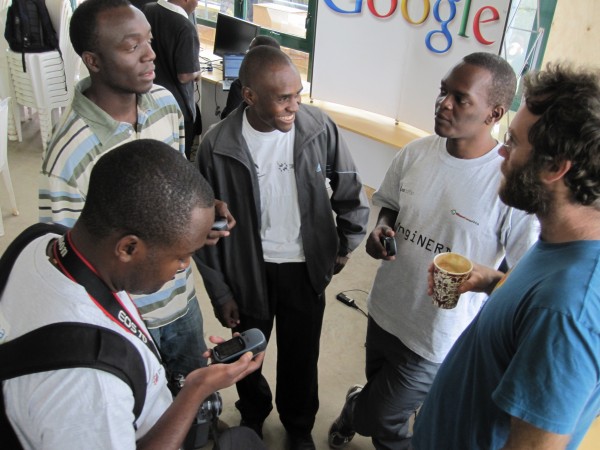
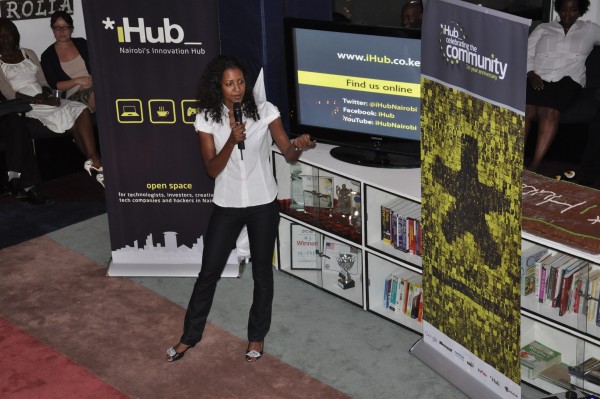
EDIT: Wanted to add some pictures that bring me the memories of the faces and events of the past few years.