Category Archives: Random Thoughts

Kenyan Techies: Secondary School Survey

[Update: I've decided to keep the survey running for a little longer to get the late comers. If enough fill it out, I'll republish the results.]

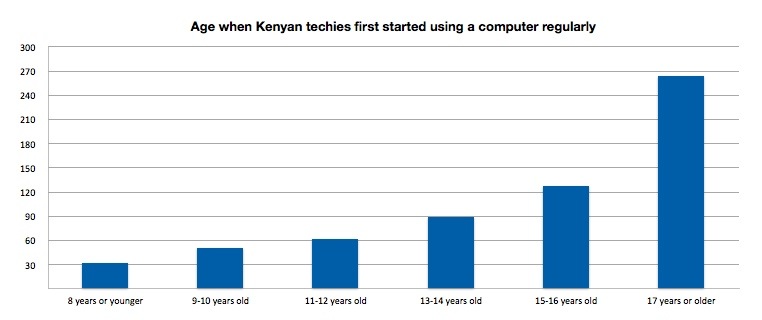
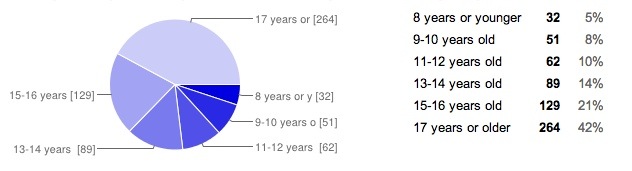
Out of curiosity I put out a survey to the Kenyan tech community 2 days ago. I’ve always wondered which schools in Kenya put out the most people who move into positions within tech companies, or start their own. I now have 200 entries, which is a decent enough size sample, though I know if we did a true canvasing of the entire community that the results would be slightly different.

[2010 Kenya Techies School Survey]

Here are the results

The top schools
Kenyan technologists - schools attended

Starehe Boys’ (20) leads by a large margin, followed by the other big private schools; Strathmore (9), Lenana (8), Nairobi School (8), Alliance (7) and St. Mary’s (6). It’s clear that some schools choose quality over quantity, such as my alma mater Rift Valley Academy (2)… :)

There are a plenty of examples, such as Gitwe (1), which had only one graduate that come from all over the country. Clearly, many techies here in Kenya had to fight their way up from a challenging environment.

Year Graduated
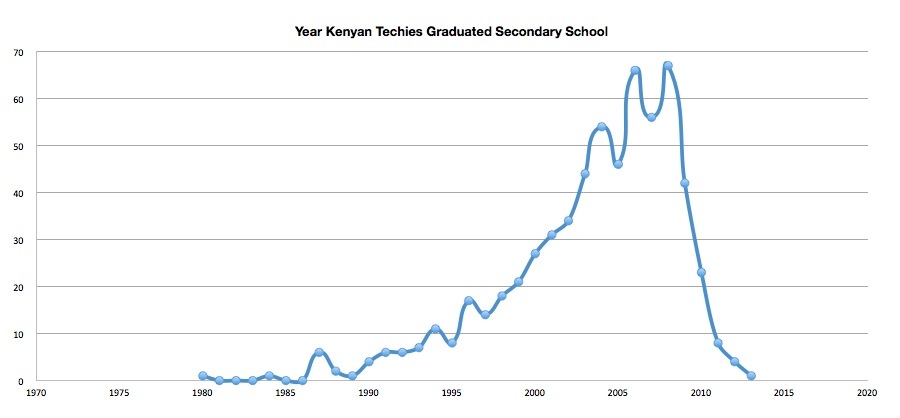
I started this off in 1980 and went to 2009. There’s an interesting curve happening within the community on when people cleared school. The highest is the year 2000 (25). I wonder if there was something that happened in the school systems at this time to make the number go up, or if there is some other reason for that bump in 2000-2002.

Kenyan Technologists - year finished secondary school

Companies you work for
I was amazed at the number and spread of technologists across the tech companies in Kenya. Here is just a small sampling of 127 different companies that were listed of who people work for:

Access Kenya
AFRICOM
Cellulant
Craft Silicon
Dotsavvy
Google
IBM
Kencall
Mobile Planet
Mocality
Nokia
Safaricom
The Standard
UN (different groups)
Virtual City
Wananchi Group

Making Ushahidi

[Below is my Tech4Africa talk, given today in Johannesburg, South Africa, titled "How we built Ushahidi, w]

I’m used to talking about Ushahidi, and as all of you guys who frequently talk about your product or company know: it gets old spouting off the same old stuff over and over again. That’s why I’m excited about today and for being invited to this excellent conference, since I’ll be telling the backstory, the quirks and funny bits that got us to this point and made our Ushahidi culture what it is today.

This is my story of Ushahidi – Of a small organization that dislikes hierarchy and being told what we can’t do. One that questions everything, embraces innovative thinking, takes risks boldly, and sometimes learns the hard way that we’re human after all.

In January 2008 I spent a week watching news reports roll in from Kenya, frustrated. Frustrated because I had said for years that “technology helps us overcome inefficiencies”. Wasn’t the madness of Kenya, in it’s post-election violence throws, it’s lack of media coverage, and lack of real information just this? Why was I unable to do anything?

It turned out that I needed an idea, and for once I couldn’t come up with one on my own. That seed of an idea that grew into what you see today came from a simple bullet point by my friend and fellow blogger Ory Okolloh, asking if we could map reports of violence around the country. Thus Ushahidi was born.

I’m going to walk you through three defining moments for our organization, and our platform, not all of them pretty, but which make us who we are.

1. Let’s look at the ad hoc cast that got it started:

The Ushahidi Team - circa Jan 2008

Ory Okolloh – lawyer, blogger and Kenyan political pundit
Juliana Rotich – renewable tech geek, blogger and database admin
David Kobia – developer and top Kenya forum webmaster
Daudi Were – blogger and web guy
Erik Hersman – Africa tech blogger, web guy
Others – a various cast of tech and non-tech people swarmed around the first Ushahidi deployment in Kenya, helping with small tasks and then disappearing.

Key points:

  • You’ll notice that there was not a single one of us who had any humanitarian experience
  • None of us had taken part in any open source project. (v1 was built in .NET)
  • Most of us were self-employed, running our own businesses or consulting, and didn’t like working for big companies.
  • The only common denominators that we shared was our love of our home; Kenya, and the ability to blog.

Thus, we felt we were the best placed to create an African open source platform for crowdsourcing information, our tech gift to the rest of the world.

We didn’t think of that at all actually. Instead we were madly Skyping, emailing, wireframing and coding over a 3 day period to get something up as quickly as possible.

We were brutal about every decision:

  • If it wasn’t absolutely necessary, throw it out.
  • Pick a name, any name, we don’t care if non-Kenyans can’t say it, just get a domain up asap
  • Launch this app, it’s functional, we’ll fix bugs and features on the fly
  • No one has a short code for us yet? Screw it, it’s not worth waiting, we’ll get one eventually.
  • Money, what’s that for? Media budgets are overrated, we’ll blog it.
  • We don’t have a logo. Oh well… Launch already!

How our team came together, the way we made those initial decisions and how we interacted and leaned on what would become our community was defining. It still colors how we operate, our organizational communications and our community focus.

Lessons learned:

  • This taught us to keep a shallow and wide decision-making structure so that everyone had access to all the information about ops or platform that they desired. Anyone was empowered to make decisions, since thy understood the macro-game.
  • Release code early, it’s better to have it out and being tested and worked on in the real world, than hidden away in a sandbox somewhere.
  • If you want it done, build it yourself, don’t put it off onto another team member.
  • Community = success
  • No money, no worries. Build good stuff and good stuff happens, money follows.

2. Technology is only a tool

allocation

No background in open source projects meant that we had little experience in how to engage programmers, designers and the help needed to get things moved from that initial .NET build into an open source language. David and I were trying to decide what language to write this in, and we ended up picking PHP over Python since we thought more African programmers would be proficient in it.

David wasn’t a PHP guy (yet), so the early helpers, the volunteers like Jason Mule, Henry Addo and Chris Blow were a huge help in making the decision to go with the Kohana framework and a myriad of other decisions.

3 months later we announced v0.1 of “THE NEW AND REBUILT USHAHIDI PLATFORM!”

We were very excited, after all, wasn’t this the platform that would save the world? And we were ready to show the world just how it could be done. Gamely mounting our white steeds we charged into a deployment of Ushahidi in the troubled North Kivu region of the DR Congo.

Echoes of that failure splatting against the ground remind us still, today, of the complexities of the space we build software in. We learned from those lessons though, and Ory wrote a good blog post making sure that it was shared within and without.

Lessons learned:

  • Technology is only 10% of the solution needed. The rest is administration and messaging.
  • Stick to what you do well. Our team is built to build software, not be a deploying organization
  • (caveat! We do help in deploying rarely, like Haiti and Kenya, but we now pass those off, or partner)
  • Own your failures publicly, learn from them.

3. Enter the failephant!

The Ushahidi Failephant

Only a few months later, after the DRC debacle, we were rested and ready to fail again.

Al Jazeera had used the alpha version of the Ushahidi platform in Gaza, a group of organizations and individuals were deploying it to monitor the worlds biggest elections in Indian, and we had a number of groups in East Africa testing it out.

Our model was that we had a small team at Ushahidi whose job was to come up with and guide the core architecture of the platform. Volunteers also worked on core, but were also encouraged to extend the platform in their own ways. It was working very well, and still does.

We were ready to release the code publicly.

Before I say anything, let’s revisit that point earlier about none of us having eroded on an open source project before…

Preperations were made, blog posts were written, tweets were tweeted – and we got lambasted by one of the guys we respect a great deal in the open source community. Rabble called us out on all the things we did wong.

- The code repository was behind a user/password wall
- We weren’t available in the normal programmer channels like IRC
- Hard to plug into the rest of the dev community

Our team went to work, madly working over the next 12 hours to get our stuff straightened out. Finally I wrote another blog post, introducing our failephant mascot and apologizing for our ignorance and missteps.

Lessons Learned:

  • Listen and apply that listening to real changes
  • Again, own your failures. Fix things that are wrong.
  • It’s okay to think different in how you execute on a project as long as you don’t stray from the spirit of your community and self
  • .

Finally, I’ll end with this.

We’ve learned that technology does overcome inefficiencies, but that it still takes people to make it happen.

We’ve learned that more people need to buck the status quo, that questioning everything makes us better.

We’ve learned that Africans can build world-class software, and to expect nothing less.

TED Thoughts: Where Gaming is Taking Us

TED is the type of conference where you’re drinking from the fire hose and, with the 18-minute talks marching onward every few minutes, you have little time to reflect on what you’ve heard before you’re onto the next. It’s been two days now, much of it spent in travel, reading and reflection and I’m starting to string a couple of thoughts together that I find at the very least interesting. At the most disturbing.

On the technology side, there were three talks that made me sit back and consider their repercussions, especially as I think of their tracks vectoring in on each other.

It’s a pretty interesting time that we live in; where giant databases are learning about us by applying Myers-Briggs testing to millions of people through a game, where both software and hardware can self-replicate, and where you can control virtual actions and physical items with your mind.

Gaming

I’ve been playing computer games since I was about 8 years old, when a friend in Nairobi got a Commodore-64 and I learned how to use those dastardly cassette tapes to bring fantastical new realities to life. What happens when a gaming generation looks at the tools and devices being built? I don’t think any of us know quite yet, but sometimes, in the minds of sci-fi writers that we see a future that could be.

On the flight back I read the book Daemon, by Daniel Suarez. It’s a mixture of hacker and gaming culture set in a fantasy world of techno-pessimism and a doomsday scenario that will get a geeks blood flowing. Well worth the read, a perfect airplane book.

Now I’m on to Fun, Inc, a book about “gaming being the 21st century’s most serious business”. It’s a $40+ billion dollar industry, and it’s not slowing down. Virtual worlds and currency are here to stay.

In Milo, I saw what looked like a fairly unimpressive game, but one with a very impressive gaming and AI-training engine. It’s next iteration will be significant indeed.

I talked to Tan Le about the Emotiv device and how I thought that her ideas of it being used for practical purposes like closing shades and turning on lights, though sounding less juvenile, would likely be overshadowed by its use in the gaming world. In fact, I can’t wait to see the first big gaming companies using the Emotiv SDK to create new user interactions, HUDs and options in popular games.

All of these vectors of technology are, at once, both exciting and scary. I don’t know where gaming is taking us. What I can’t help but think is that gaming, and possibly the culture behind it, will be the vehicle that drives mainstream technology use and growth of the talks and demos that I saw at TED.

A Question of Culture

[Caveat: I am no philosopher, nor have I done any research on this. These are just a few meandering thoughts and broad generalizations brought on by boredom while riding the London to Oxford train.]

Acacia tree on the grassland

The biggest difference between Africans and Westerners might be in how we define value.

A Westerner sees a tree and loves it for it’s aesthetic beauty.
An African sees a tree and loves it for it’s practical uses; for shade, or how much it can be sold for.

This comes out in small and large ways. Many times the differences and definitions for why we do things differently are difficult to notice, they’re nuanced, leaving only a vague sense of confusion of why a certain decision was reached by a person from the other culture. At other times the cultures stand gawking at one another wondering which planet the other came from.

This isn’t to say that Westerners can’t see practical uses or that Africans are unable to appreciate aesthetics. No, it means that a different starting point on decision making can create a wide number of outcomes, many of them widely divergent to our own cultural world view.

Being in Africa Makes You Untrustworthy

I haven’t been able to use PayPal for two months. I just got profiled for extra security measures on Facebook. I can’t make certain purchases from Africa. Few organizations ship goods to me here.

Let’s be honest; living in Africa, or being African, gives you a certain unwelcome aroma in the eyes of global corporations. Frankly, we’re just not trustworthy.

The Africa trust problem

This isn’t new to any of us who live, or spend a great deal of time, in Africa. You’re blacklisted, given extra screening, and generally treated like a second-rate human. You’re not trusted, and you’re not worth the time to figure out if you can be trusted.

Frankly, as a total continent-wide user base, we just don’t make enough of a blip on the radar to be worth their time. There’s not enough money here in their minds, there is lower-hanging fruit elsewhere with a lot more spending history – and therefore power.

Does it make it right? No. Do my own stories of wrongs and misbehavior matter? No.

Jon Gosier states it well when reflecting on his blacklisting by PayPal (one of the very worst company offenders):

“Once again, the message perpetuated here is to be cautious when dealing with Africans, Africa or anything you suspect of being related to the aforementioned.”

A closer look at African cyber crime


From the Internet Crimes Complaints Centre (IC3) 2009 Annual Report [PDF download]

Nigeria has a significant 8%, but Ghana, South Africa and Cameroon all come in at a measly 0.7%. How in the world do Africans get so much worse treatment for so little compared to the others? There’s no doubt that one country in a continent of 52 countries has a problem – we all get punished for it.

Here are some more interesting statistics, according to the Consumer Fraud Reporting statistics for 2009:

“The majority of reported perpetrators (66.1%) were from the United States; however, a significant number of perpetrators where also located in the United Kingdom , Nigeria , Canada , China, and South Africa.”

So, there are two strong Africa contenders for fraud, but it’s amazing how much more hell internet consumers in African nations (outside of Nigeria and South Africa even!) have to go through in comparison to their much more cybercrime-ridden finalists like the US, Canada and the UK…

Texas in Africa puts this well after a recent foray into this space with Delta:

“it also reflects knee-jerk prejudice and the willingness to write off an entire continent of people as liars and cheaters. The consequences of this attitude are far reaching”

Too true, and there are only two ways that this might change:

First, we in Africa come up with our own payment and business solutions that work here first, and then interact with other global systems.

Second, the global corporates wake up and realize that there is quite a bit of spending power and money to be made in Africa, just like the mobile operators found out in the 90′s.

Strategic Retreats

[Note: this is a long story about the last couple days in Northern Kenya, where I still am]

Reaching Lake Turkana was one of the big steps we needed to do along the way for our excursion into the Northern part of Kenya. It was adventurous, but little did we know that it was just setting the tone for the rest of the trip.

Larachi is a small town East of Loyangalani as you head towards Mt Kulal. It’s nestled in a ravine with a about 170 families consisting of the odd mixture if the warring Samburu, Turkana and Arial people groups. They have a school, but no teacher, since all teachers refuse to come due to lack of water. We spent a warm day in the hot sun discussing this with their elders and the possible building out of a gravity water system by Food for the Hungry.

We started to see clouds coming together around noon, deciding it was prudent to make a move away from the mountain into the stony soil around the lake. This also gave us another chance for a quick dip to cool off, Erik some time to fish, and to drink a pot of chai.

This is when the rain started.

Contrary to popular belief, it does rain in the NFD, but not much. Currently it’s green and vibrant, contrasting with the normal dry, brown, dusty and arid state that you usually find it. That too isn’t abnormal. What is, is the fact that it’s been raining across the north for the last 3 days, flooding an already wet desert. People who have lived here for over 20 years have never seen it this way.

Mt Kulal

We made it to the top of Mt Kulal, to the town of Gatab that sits at 5800 feet, that evening. Kulal is God’s viewing point for all of the north. It’s a lush, green, forested environment that serves as an oasis in the desert and haven for weary travelers, such as ourselves. We could see it raining all across the horizon, from Marsabit to South Horr and even over Lake Turkana.

Besides having the chance to sleep in a non-convection oven type environment, it also provided us access to the only other hospital in the area to re-bandage my hand (Frankenstein stitches and all). We pitched the tents in a friend’s plot of land, after a great evening of chai and fish (Talapia) that we had brought up from Lake Turkana.

At 2:00am it started to rain. Not just any rain though, this was big rain, the type that feels like someone is pelting your tent with golf balls. After 10 minutes it let up. A hasty debate on the merits of pride and honor verses the fact that we had sited the tent on a strategically poor “river valley-like” side of the hill ensued. Shortly after, we made a strategic retreat for our friend’s house and piled onto the floor. That whole night I slept with a grin on my face as I heard the rain battering the mabati (sheet metal) roofing, while I remained dry and comfortable.

The next morning we found our tent 10 feet further down the hill, upside down and swamped with water. Barak and Pam’s tent was of better quality and better sited, so they emerged dry and calm the next morning. Lessons were learned.

The Run to Korr

Arapal, a town directly on the other side of Mt Kulal from Larachi was our aim for yesterday. They have had a water project going for a while, and their community has benefited greatly from it. Our goal was to hit their community, and then try to make it to Korr by the end of the day. A long day of driving, but very doable (most of the time).

By midday we again saw clouds forming, big thunderheads forming to bring the hammer of rain down on the desert. Our planned route from Arapal to Korr via Karagi we were told would be a great risk. Plan B was hatched to make a run back south of Mt Kulal and to the gap between the mountains where South Horr resides. This would be two times as long of a trip, 6 hours instead of 3.

We made a mad dash for South Horr, knowing that the rains we had seen over the area the day prior and the clouds we saw forming that day, were likely to leave us with some tough choices. By now those who know the North will realize just how much crisscrossing of the area we were doing. Our diesel was starting to run low, and there are no petrol stations anywhere. We begged some from the nun at the catholic mission in South Horr and set off for the gap.

Just after the mountains, the road splits. One branch heads directly towards Korr, the other takes you through a beautiful valley within enclosing arms of high cliffs, where you will find the town of Ngurunyet. The branch towards Korr was closed. We gamely turned towards Ngurunyet and ran until after dark to get there, only to find out that the rains had closed down the road from there to Korr completely.

It was time to camp again. We found a place by the river and held out until morning, hoping and praying that it didn’t rain. It didn’t.

Hitting Korr

At this time, you can imagine what this feels like. You’re trying like mad to get to a location, thinking through every path and camel track that you know of to get there. Obstacles keep forming, being overcome, and reforming along the way.

Everything looks better in the morning, as it did for us today.

Marsabit was closed to us, which would get us to the main road. Maralal could get us towards Nairobi, but we’re very hesitant to go that way due to the number of shootings by the ngoroko (the Turkana bandits) along that route. Korr, is where Erik used to live, where he has a house and where we can camp out for a few days, hoping that the land dries out so that we can make a run for the main road and Nairobi.

Distances are deceiving in Africa. You might be only 30-40 kilometers from another town, but that town could as well be another continent if you try to reach there during the wrong season.

Under hastily muttered prayers and hopes of a nyama choma feast in Korr, we set off. Things were going well, we had been joined 2 days previously by another vehicle full of Kenyan Food for the Hungry staff. They knew the paths, and knew how to drive. Unfortunately, like us, they were driving a large, long wheel base Landcruiser.

A Short Aside on the Merits of Landcruisers vs Land Rovers

There is a long-standing battle on which is better: Landcruisers or Land Rovers. Erik and I represent the two opposing factions, with him in the Land Rover side of the debate and myself on the Landcruiser side. Regardless of what your emotions might tell you, the Land Rover’s weak aluminum body does make it lighter so it does perform better in boggy and muddy conditions.

As we were the first to trek out upon this road since the rains, we had to do a lot of testing before we entered into questionable areas. Fine driving by Erik and Peter got us through most of it, until we found an area that looked like dry sand, but which had about four feet of soupy mud beneath. An hour of digging, finding rocks and lifting the vehicle later, and we were free.

I now sit in Korr, drinking some homemade lemon juice and basking in the glory that is a cool breeze after a much needed shower. We’re completely boxed into Korr now, but there is a small airfield here, even if there is no internet of mobile phone connection. For now, I’m just happy to have a dry place to sleep, a healing hand, and the knowledge of an adventure now behind me.

The People You Work With

There’s no greater joy in (work) life than doing what you love with people that continually amaze you and with whom work isn’t considered work.

Two years ago none of us would have realized that an ad hoc group of blogging friends and techies would grow and become an organization of our own. I don’t work at Ushahidi due to the tech or the challenges, though both are great perks. I stay here because of the people I get to work with every day (virtually).

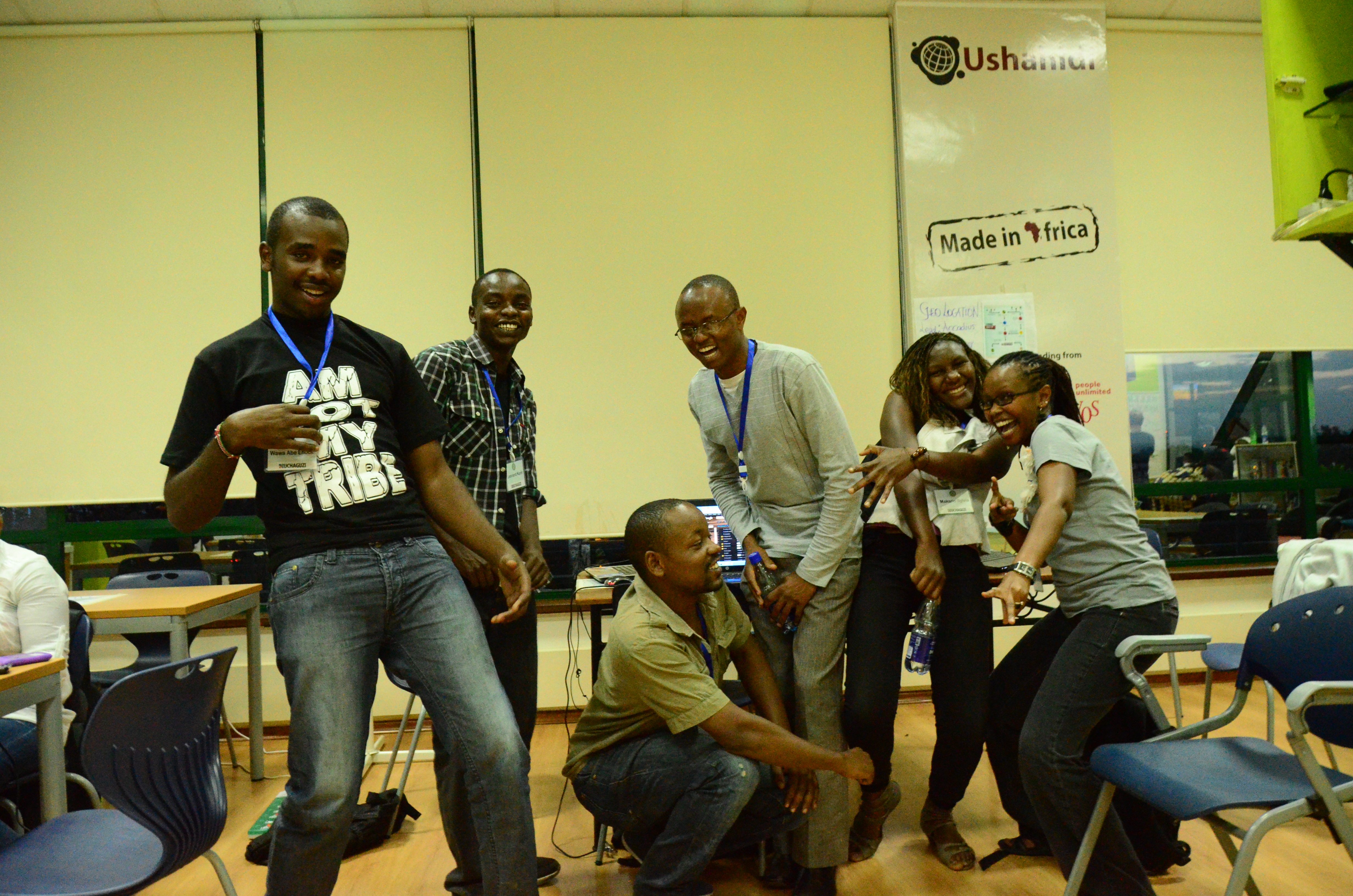
This is a picture of the Ushahidi core team (minus myself). It’s been a pleasure to work with each of them, even through the hard stuff.

Quick hits around African tech

Google’s Code Jam Africa is underway, and top African programming talent are working to solve some tough algorithmic challenges.

Idd Salim gives us, “10 Kenyans Under 32 will be USD Millionaires before October 2010” or, his thoughts on how to make big money in the web and mobile space.
(related, how to make money with Safaricom)

Foreign Policy writes a scare piece on how a high-speed wired Africa dooms the world to powerful botnets
(related blog post)

AllAfrica covers Sophia Bekele’s .Africa project, trying to get a TLD set up for Africa (a la www.whiteafrican.africa).

Inside Facebook points out the slow and steady growth of Facebook users across Africa.

Finally, in the not-tech-but-interesting category we see the blurring of the US military and development/aid programs and how this new “smart power” is going to mean more US military industrial complex members invading Africa.

Geeking out on a Motorcycle Trip

Today I had a lot of fun, one of my old schoolmates (Markus) from here in Kenya asked me if I wanted to get out of Nairobi and hit the trails on our motorcycles. Of course, the answer was yes. We headed out towards Naivasha early this morning and then took a side road off towards the escarpment.

The roads are dirt and with the recent rains they’re really quite rugged and beyond most normal vehicles. Markus is an experienced trail rider on a KTM 450 (kitted out), I’ve ridden a lot of trails, but years ago and not nearly as experienced as Markus – and I’m riding an offroad/onroad Suzuki DR 650 (stock).

We ended up having to run through, and beside, a lot of 5-10 acre farms that sit at the base of the escarpment in order to find a road up to the top of the escarpment. A lot of this was on cow paths and required some fine-tuned leveraging of our bikes through gates and streams. The road to the top of the escarpment, when found was a fun ride, minus the part where I wiped out on a simple turn (the one below)…

Bruises (and bruised ego) aside, we kept going up into small-farm, where quite a few more people live, and which is almost entirely denuded of trees that were there just 15 years ago.

After talking to some of the local community, we were advised to head down a certain road, with assurances that it would lead us to the bottom of the escarpment. It did, eventually, but not until we had backtracked, sidetracked, followed animal trails (in buffalo country), and then realized that the washed out gully we were in was supposed to be the road.

3.5 hours of wrestling a mammoth 650cc bike through this terrain left me exhausted. This type of bike is not made for that level of technical riding down boulder strewn gully’s and game trails. However, it was also hugely rewarding when we finally found our way to the bottom of the escarpment and much easier riding.

Mapping the Malewa Motorcycle Trip

I also brought my Android Nexus One along for the ride, hoping that the battery life would allow me to use it for tracking our trip. The Nexus One has a GPS, and there’s an Android app called My Tracks, that tracks your trip, allows you to add waypoints, then easily shares it to Google’s MyMaps.

Here is the result:


View Malewa Motorcycle Trip in a larger map

It doesn’t look very exciting like that, but it does give you the exact data for having your own challenging ride if you’re in Kenya.

Heading Home

You might have noticed a lack of posts, or at least an erratic nature to my blogging over the last 6 weeks. This is due to the fact that I’ve been packing up and getting ready to move my family back to Kenya after living the last few years in the US. I won’t lie, it’s been pure madness and I apologize to all the people who I didn’t answer emails from, return calls or tweets…

Nairobi Skyline

I’m very excited though, as this is where it’s happening. Nairobi, where I’ll be living, is one of the four main technology hubs in Africa (Jo’burg, Accra and Cairo being the others). Nairobi is also home, that’s where I grew up and where I know the most people. It’s where I can relax and eat nyama choma (which I will do in abundance). :)

Why?

Checking out the latest Ushahidi build

Nairobi is also where Ushahidi started almost 2 years ago (wow, time flies!), which is providing the means and the reason for this move. There will be two main activities that I’ll be involved with:

  1. I’ll be working with the Nairobi programmers, designers, end users and members of the Ushahidi community in person. (These guys and gals are already rockin’ it, wait until you see the “Mogadishu” release of the code next week!)
  2. My other main focus is opening up an innovation hub, a physical nexus point for the tech community in the city. This hub will also be a place for us at Ushahidi to reach out and better engage with our own user and dev community.

There is a slew of big announcements coming out on the Ushahidi-front over the next week. I’ll be in the air for the biggest of them, but will link to it when I land. Keep an eye on our blog and twitter feed for more.

Leaving

Alex and Me

Orlando has been a good home base for us. While it might not be the tech capital of…well, anywhere, it’s still home to some amazing people and we’ve loved being a part of it. A big thanks for the friendships and a shoutout to those techies who have made Central Florida home:

Chris Scott, Alex Rudloff, Josh Hallett, Ted Murphy, Scott Allen, Dawn Hatton, Gregg Pollack, MindComet, Paul Lewis, Cory Collier, Bill Ferrante, Celly, Bill Dean, Etan Horowitz, Ryan Price, Eric Marden, Jason Seifer, John Rife, Ochie, Alex Spoerer, Doug White, Robert Jordan, Jim Hathaway, Robert Shade, Scott Toncray, Damian Scott, Chris Droessler, Allison Jordan, Gavin Hall, Gabriel Chapman, Jermaine Pulliam, Josh Lindsey, Marcelle Turner, Jon Shuler, (and many others I’m forgetting)…

I think of all the great BarCamp Orlando’s, BlogOrlando’s, Likemind and Florida Creative meetings… For a small tech community, it does throw an awfully big punch.

So, a big thank you to all the friends and family that have made this next chapter in our lives possible. We’re looking forward to it. All will be the same, just from the Kenya primarily.

Creative Juices

What gets you thinking creatively?

I’ve been thinking a lot about the need to have more time spent away from the normal timesinks that define our working lives. Getting more dead time. Daydreaming time. Doodling time.

My main ways:

1. Daydreaming

I had 10 hours of driving time on Friday. That’s the perfect environment for me to get some thinking done, I’m unable to escape to the digital tethers of mobile phone or computer, and reading a book isn’t possible. Therefore I think, and seemingly unrelated patterns start to become apparent from different projects, people and initiatives that I’m involved in.

Daydream logo

This fits in with an article I read on Fast Company recently, “Hard Work’s Overrated, Maybe Detrimental“.

“By most measures, we spend about a third of our time daydreaming, yet our brain is unusually active during these seemingly idle moments. Left to its own devices, our brain activates several areas associated with complex problem solving, which researchers had previously assumed were dormant during daydreams. Moreover, it appears to be the only time these areas work in unison.”

Honestly, I don’t do this daydreaming stuff enough, I need to do it more. My goal is to untether myself from my iPhone and books more often. Some of my best ideas last year came from an airplane flight where I forgot my book and my iPhone was dead, leaving me with 5 hours an pen and a notebook…

2. Doodling

I used to draw a lot, but about 7-8 years ago I just kind of stopped. I’m determined to get started again, even if it is just doodling spaceships in a notebook.

Closely related to doodling is finding crazy, yet professional and cool, images that inspire me to strange thoughts. Case in point…

Snow Zebara

Good blogs to follow for occasional posts with reams of these types of images are InstantShift or Smashing Magazine.

How about you?

I’m very interested in hearing how others get their creative juices flowing. At some point we all have to shake up the norm, the status quo, in our lives or work. Is there a way that you do this purposefully?

Trusted Intermediaries

If you’ve run into me in the last couple months you’ll likely have heard me talking a lot about the need, power and abilities of trusted intermediaries. What is a trusted intermediary? It’s someone who sits between two parties, entities or ideas that don’t naturally trust each other and provides a bridge.

Do you trust this bridge? Why?

Do you trust this bridge? Why?

In some ways, this train of thought stems from the posts on bridgers and xenophiles started by Ethan Zuckerman and riffed on by myself. It’s only as my continued work in the African tech space has evolved that I have come to understand the true value of this concept. Seeing my position makes me realize how valuable it is to be trusted and in the center of a group of unknowns (ideas, funding, people or projects). It’s in the unknown areas of our lives that we search for trust, for people or conduits that impart a measure of confidence to our next decision. For the nod that tells us we’re heading out on the right path.

We lean on trusted intermediaries all the time, in both mundane decisions and important interactions. When you’re looking for a mechanic, you’ll trust your neighbor’s opinion over the phone book. If you need a new bike helmet, you’ll trust online reviews before you buy one with no reviews. Likewise, when you’re going to make a large investment in the African tech space, you’ll search out trusted intermediaries first.

A case study: Ushahidi

When someone is looking to invest in an African tech startup, using seed funding or grants (and it is the same for non-profits or for-profits) they are nervous. There’s a lot of other good ideas out there in other parts of the world, the low hanging fruit, that they feel more comfortable in putting money into. Why Africa? Why you?

Ushahidi started off quickly, and we were able to raise funds for continued operations much faster than many other similar non-profit tech organizations. While we’d all like to think it’s due to the brilliant tool we’ve built, we have to be honest and recognize that the individuals behind it are what gave the funders confidence to move forward. Ory, David, Juliana and I had been on the public stage for a while; we were known quantities.

We were trusted intermediaries before Ushahidi was even thought of. Which begs the question: would our team have been able to raise funds for almost any idea just as easily? Probably not, as the Ushahidi idea, timing and application are special. However, the point is still made, money flows when the people are trusted.

Trusted intermediaries elsewhere

Jon Gosier is a trusted intermediary. His Appfrica Labs incubator and innovation center in Kampala provides a person and entity that funders, projects and individuals are drawn too. His blog keeps him front and center in people’s minds.

Glenna Gordon is a trusted intermediary. She’s a photographer who has been romping around Central, East and West Africa for a couple of years. If you need a pro shooter in a hard spot like Liberia, you’ll find her blogging away at Scarlett Lion.

Eric Osiakwan in Ghana is a trusted intermediary. His leadership at the African ISP Association and the track record he’s had on projects makes him an easy person to go to in West Africa, and his Internet Research firm makes a perfect conduit for interacting with him.

Of course, these three are just a sample, there are many more like them cross the continent in different fields.

What is consistent about trusted intermediaries is that they have found a way to create a bridge between two things, and are trusted by both sides of that bridge. It’s why personal relationships, consistency, reliability and trust are more important now than ever before.

When do You Need Funding?

I’ve spent the last couple days in scenic Salzburg, Austria with 20 other people from both traditional journalism and new media backgrounds. Our goal: discuss strategies for more effective engagement and investment in “tomorrow’s media“. There are a mixture of organizations in the room, some established and others start-ups, like myself representing Ushahidi.

One of the questions posed, and which I’ve been ruminating on, is “when do you need funding?” (At this particular meeting, we’re talking grants primarily, but this applies to traditional seed and VC funding as well.)

Invest in Doers not Talkers

972816_tape_measureI don’t think it’s as early as most people think. There are a lot of people out there who claim they need funds in order to build a product. I disagree. Your first job is to build it. It might be in your nights and weekends, but that’s to be expected.

Yes, at a certain level you need funding that allows you to live, feed yourself and grow a business, but that’s not until you actually have something to show. Why would you expect someone to pay you money for a good idea? There are good ideas everywhere, but few examples of great execution upon these ideas.

A great presentation, Powerpoint or speech will get you a long way, and the ability to communicate is essential in both getting funding and getting user adoption or partners to work with you. However, nothing sells a good idea like a working product.

Whether it’s building a prototype, like we did with Ushahidi in Kenya, or a couple guys in a garage creating a new search algorithm and having to shop the product of that research around before they find investors, it’s too be expected that the work comes first, the funds second.

Growing

When is funding needed then? It’s needed when you have a product and it shows potential for success. Where you can talk to smaller investors who can support your work a little longer so that it can be refined and grow into something that has a real chance to make a difference, make money or both.

The second level of funding is about scale. It’s when you have a proven product that already has some success and needs more than it’s current cash-flow, or personnel, to take it to make a broader impact.