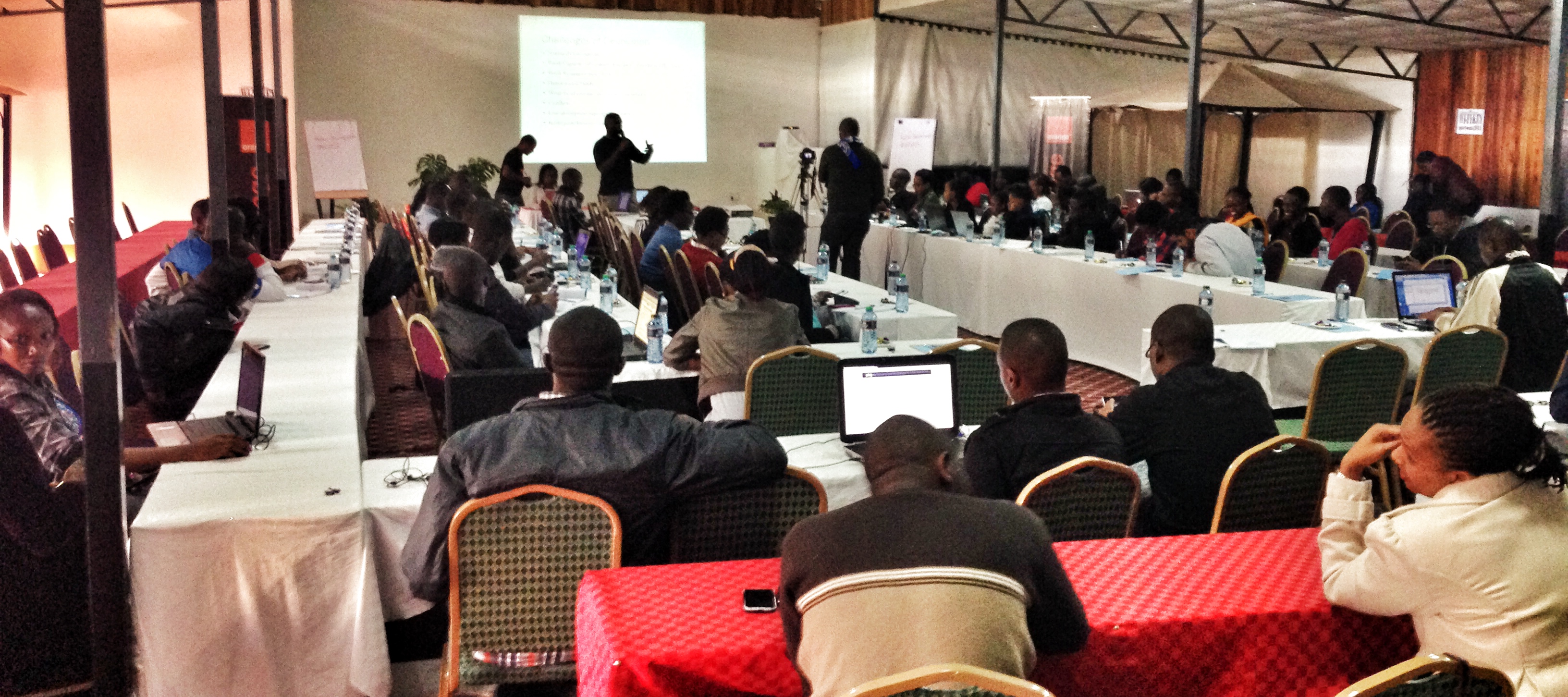
WordCamp Kenya 2013, Nanyuki
Today finds me in Nanyuki, Kenya at WordCamp Kenya 2013. The past couple years, I’ve been traveling during the event, but this year I get to come hang out with my blogging brothers and sisters.
As I was thinking about what to talk about, I thought I’d cover four areas:
- Why we blog
- My rules for blogging
- 3 things that are bothering me in the Kenyan blogosphere
- Using blogging as a tool
Why We Blog
“No, no! The adventures first, explanations take such a dreadful time.”
– Lewis Carroll
The best bloggers are storytellers, they take you on a journey. They tell you why you should care about things, they’re opinionated and informative, and they understand what makes things interesting to their readers.
My rules for blogging

Commitment: to be a really good blogger, you have to commit to it for a long time. Success doesn’t happen over night, and if you take it seriously and really put your mind to it, you can leverage that for much greater things in the years ahead.
Quality: take the time to write well. Sometimes I’ll write a 4 paragraph blog post and it’ll take me more than 2 hours. That sounds ludicrous, but it’s because I’m trying to find the right phrase, link to the right places and put the right images in that make this worth someone’s time to read.
Consistency: this is where I’ve been falling down over the last year or so. If you consistently publish quality blog posts, you’ll gather a following and generate a community around what you do. I blogged consistently, 3-4 times per week for two years before I really got noticed. It’s important to remember that blogging is a long-game, and that if you stick with it, it will pay off.
3 things that are bothering me in the Kenyan blogosphere
1. The Kenyan elections
Back in March of this year we had the prolonged (5-day) Kenyan elections, where there was a lot of tension. Where I believe we traded “peace” for truth. I wasn’t surprised that the media didn’t do their job. I was surprised that there were so few bloggers who did theirs. I took a lot of heat for creating the IEBC Tech Kenya blog on Tumblr to track the facts around the IEBC technology failures, but I kept wondering where the other bloggers were.

One person who did blog was @Gathara, and boy did he blog well!
Our job as bloggers is to be independent voices, and we’re most powerful when mainstream media isn’t doing their job. When we do this blogging in a timely manner and get that information out there quickly and in a well-researched and circumspect way. We need to get back to our Kenyan blogging roots, which were just like this back 4-7 years ago.
2. Corporate sponsored bloggers
Making money off of blogging is fine, nothing wrong with that. I’m tired of cut and paste blogging though, where people take press releases from a corporate and get paid to just paste it with no changes. I want to know why what that company is doing is interesting, why I should care. I want to know what your opinion is.
Don’t sell out and lose your identity.
3. Kenya’s new media laws
Kenyan MPs have approved a contentious media bill that journalists say amounts to government censorship
I see articles on the East African, the Telegraph, the Nation, but only a couple blogs show up in Google search results.
Why? Already we have loose set of laws around media and information, it’s a slippery censorship slope that hurts all but the powerful in Kenya. This new law makes it even worse, it smacks of Moi-era censorship.
Where are the bloggers using this opportunity to push back? Don’t we realize that this law applies to us too?
Blogging as a tool
My final discussion points were about how even if you have very little, you can still use WordPress, Twitter and Instagram to build a brand. I talked briefly about where we’d come from with Ushahidi and the iHub, just using blogging and social media to get on the map. Now, we’re doing the same thing for BRCK.
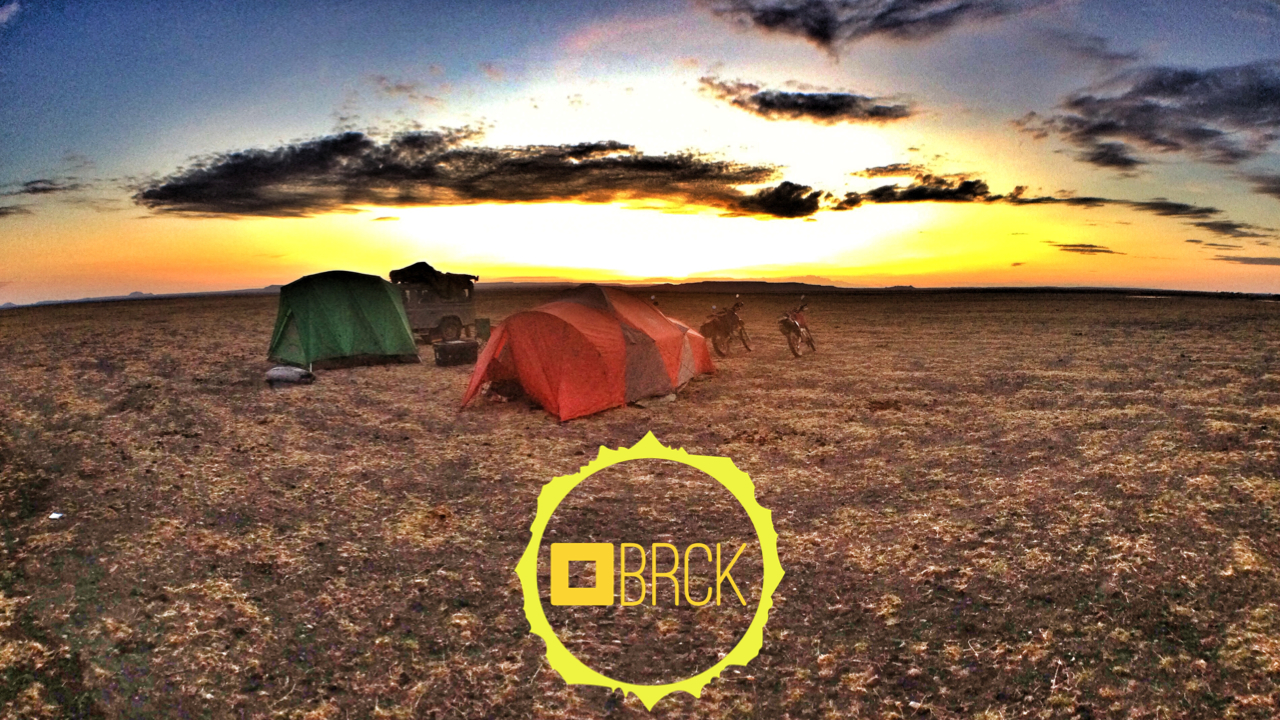
The BRCK Eclipse Expedition
I used the example and ran through the story of the BRCK expedition to Lake Turkana to catch the Solar Eclipse. I used my blog, as well as the BRCK blog to create the narrative, amplified by Instagram, Twitter and Vimeo.

Tools used to blog the BRCK Eclipse expedition
When you’re building a new brand, what you write and the images you use, help people understand what the narrative and brand is about. For us, it was important to put a stake in the sand (literally too, I guess), about the BRCK being a rugged connectivity device. Nothing said that quite like the team behind it out and thrashing it themselves (and also thrashing themselves…).
The results of this were that by the time we got back a week later, there were many more people interested in buying a BRCK themselves, but also people who now wanted to partner with us and even invest.

Telling the story, creating the brand narrative
Blogging is a long-term strategy. The Ushahidi blog has been a big part of our identity for almost 6 years. The team who built Ushahidi were all bloggers, so it makes sense that it’s part of our DNA. For the iHub the same. For BRCK the same. I don’t believe in press releases, I believe in blogging the story and if you’re doing interesting things and telling the story about them well, then the right parties will find you.
]]>The full Ushahidi team met yesterday (many virtually, of course), and we talked about many issues surrounding the Westgate siege. Not least amongst them was the fact that we had a hard time checking in with each other. And then found out that one of our team’s wife and 5 children were inside of the mall, while he was traveling out of country. They eventually got out a few hours later, to which we were relieved.
This lead us to then think through our skills and tools, and where we could be useful.
In an emergency, how do you find out quickly whether your family, your team, your friends are safe?

The Ping App – a group check-in tool for emergencies
How About a Way to “Ping” Your Group?
There was a consistent problem in every disaster that happens, not just in Kenya, but everywhere. Small groups, families and companies need to quickly check in with each other. They need to “ping” one another to make sure they’re okay. It has to be something incredibly simple, that requires little thinking to use. People have been doing some stuff in this space in the past, the best like “I’m Ok” are focused on smartphone users, but we have a need to make it work for even the simplest phones. Our goal is to have this available for anyone globally to use.
“Ping” is basically a binary, multichannel check-in tool for groups. The idea is that families and organizations could use this for quick headcounts on how everyone was, then use it as an on-ramp into a Red Cross missing persons index or something like Google’s People Finder app.
We’re putting the first version of it up at Ping.Ushahidi.com – here’s how it works:
- You create a list of your people (family, organization), and each person also adds another contact who is close to them (spouse, roommate, boy/girlfriend, etc).
- When a disaster happens, you send out a message for everyone to check-in. The admin sends out a 120 character message that always has “are you ok?” appended to the end.
- This goes out via text message and email (more channels can be added later).
- The message goes out three times, once every 5 minutes. If there is a response, then that person is considered okay. If no response, then 3 messages get sent to their other contact.
- We file each response into one of 3 areas: responded (verified), not responded, not okay.
- Every message that comes back from someone in that group is saved into a big bucket of text, that the admin can add notes to if needed.

Ping Notes, Features

Ping Architecture – rough draft
Yesterday we quickly wireframed out a list of needs, some design basics, and an architecture plan (images above), got a rough product going on it (code is on Github). We now need to make it look better, so some designers are working up some stuff to make it work well on both phones and computers.
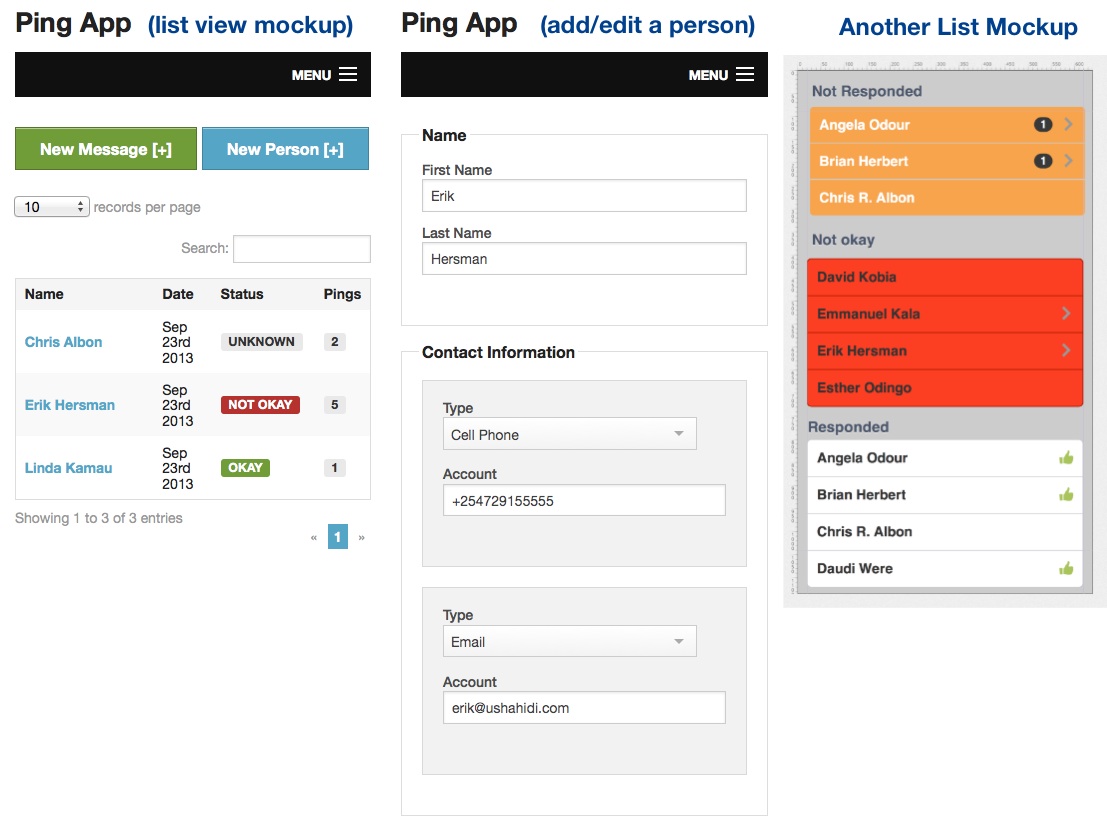
Mockups of the Ping app, still undergoing some design tweeks
Final touches are to add in:
- Account creation, we’re using our CrowdmapID tool for this, since it’s already out
- Message “send” page
- Archive old campaigns feature
- Wire into text messaging service (Nexmo or Twilio), and then testing it out internally
- Designing it so it looks good (responsive design, so it works on mobiles and PCs)
If you’d like to help out, jump on the Github repo, and get in touch with us about what you can do. What we have here is a minimum viable product (MVP) right now, open source, so anyone can make it better by branching the code and adding in features, etc.
Finally, a HUGE thank you to the people who have been burning the midnight oil to make this all happen in 24 hours:
@udezekene (visiting from Nigeria)
@EmiliaMaj (visiting from Poland)
@gr2m (visiting from Germany)
@Dkobia (Ushahidi)
@LKamau (Ushahidi)
@bytebandit (Ushahidi)
@DigitalAfrican (Ushahidi)
Too many wrongly characterize the debate as “security versus privacy.” The real choice is liberty versus control.
This is the loss of freedom we face when our privacy is taken from us. This is life in former East Germany, or life in Saddam Hussein’s Iraq. And it’s our future as we allow an ever-intrusive eye into our personal, private lives.
Many think that this debate will just go away – it won’t. This is a BIG deal, one that I think is the biggest in our generation. Do not be quiet about this. Do not let tech multinationals and your government do this.
There are many more articles on this (these are just today’s), but here’s another by Glenn Greenwald at the Guardian on the US and UK defeating privacy and security on the internet.
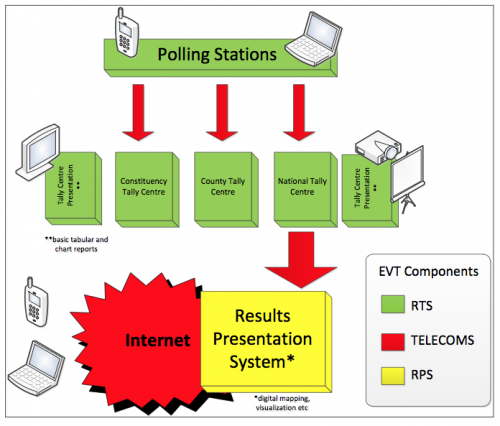
]]>Kenya’s IEBC (Independent Electoral and Boundaries Commission) had an ambitious technology plan, part based on the RTS (Results Transmission System), part based on the BVR (Biometric Voter Registration) kits – the latter of which I am not interested in, nor writing about. It was based on a simple idea that the 33,000 polling stations would have phones with an app on them that would allow the provisional results to be sent into the centralized servers, display locally, and be made available via an API. It should be noted that the IEBCâ€ s RTS system was a slick idea and if it had worked weâ€d all be having a much more open and interesting discussion. The RTS system was an add-on for additional transparency and credibility, and that the manual tally was always going to happen and was the official channel for the results.
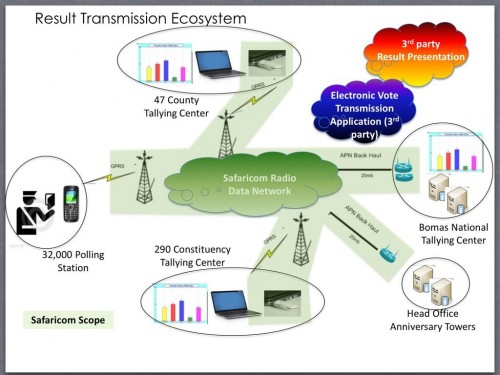
On Tuesday, March 5th, the day after the elections, the IEBC said they had technical problems and were working on it. By 10pm that night the API was shut off. This is when my curiosity set in – I didn’t actually know how the system worked. So, I set out to answer three things:
- How the system was supposed to work (Answer here)
- Who was involved and what they were responsible for (Answer here)
- What actually failed, what broke (Answer here)
Turns out, it wasn’t easy to find any answers. Very little was available online, which seemed strange for something that should be openly communicated, but wasn’t. We all benefit from a transparent electoral process, and most especially for transparency in the system supposed to provide just that.
So, I set up a site to ask some questions, add my notes, aggregate links and sources, and post the answers to the things I found on the RTS system. I did it openly and online so that more people could find it and help answer some of the questions, and so that there would be a centralized place to find the some facts about the system. By March 6th, I had a better understanding of the flow of data from the polling stations to the server and the API, and an idea of which organizations were involved:
- Polling station uses Safaricom SIM cards
- App installed in phone, proprietary software from IFES
- Transmitted via Safaricoms VPN
- Servers hosted/managed by IEBC
- JapakGIS runs the web layer, pulling from IEBC servers
- Data file from IEBC servers sent to Google servers
- Google hosted website at http://vote.iebc.or.ke
- Google hosted API at http://api.iebc.or.ke
- Next Technologies is doing Q&A for the full system
Why now? Why not wait a week until the process is over?
It’s been very troubling for me to see people speculating on social media about the IEBC tech system, claiming there have been hackers and all types of other sorts of seeming misinformation. Those of us in the technology space were looking to the IEBC and its partners for the correct information so that these speculative statements could be laid to rest. I deeply want the legitimacy of this election to be beyond doubt. The credibility of the electoral system was being called into question, and clear, detailed and transparent communications were needed in a timely manner. These took a long time to come, thus my approach.
Interestingly, Safaricom came out with a very clear statement on what they were responsible for and what they did. Google was good enough to make a simple statement of what their responsibilities were on Tuesday. both of these companies helped answer a number of questions, and I hoped that the other companies would do the same. Even better would have been a clear and detailed statement from the head of IEBC’s ICT department to the public. Fortunately they did provide some general tech statements, claimed responsibility, refuted the hack rumor, and made the decision to go fully manual.
My assumption was that since this was a public service for the national elections, that the companies involved would be publicly known about as well. This wasn’t true, it took a while asking around to get an idea of who did what.On top of that, In a country that has been expounding on open data and open information, I was surprised to find that most of the companies didn’t want to be known, and that a number of people thought it was a bad idea to go looking for who they were and what they did. I wasn’t aware that this information was supposed to be secret, in fact I assumed the opposite, that it would be freely announced and acknowledged which companies were doing what, and how the overall system was supposed to work.
I’ve spoken directly to a number of people who are very happy that I’m asking questions and putting the facts I find in an open forum, and some that are equally upset about it. Much debate has been had openly on Skunkworks and Kictanet on it this, and when we debate ideas openly we fulfill the deepest promise of democracy. My position remains that this information should be publicly available, and the faster that it’s made available, the more credible the IEBC and it’s partners are.
By Friday, March 8th, I had the final response on what went wrong. My job was done. Now it’s up to the rest of the tech community, the IEBC and the lawyers to do a post-mortem, audit the system, etc. I look forward to those findings as well.
Finally, I’ll speculate.
My sense of the IEBC tech shortcomings is that it had very little to do with the technology, or the companies creating the solution for them. It was a fairly simple technology solution, that had a decent amount of scale, plus many organizations that needed to integrate their portion of the solution. Instead, I think this is a great example of process management failure. The tendering process, project management and realistic timelines don’t seem to have been well managed. The fact that the RFP due date for the RTS system was Jan 4, 2013 (2 months exactly before the elections) is a great example of this.
Some are saying that the Kenyan tech community failed. I disagree. The failure of the IEBC technology system does not condemn, nor qualify, Kenyaâ€s ICT sector. Though this does give us an opportunity to discuss the gaps we have in the local market, specifically the way that public IT projects are managed and the need for proper testing.
It should be said that all I know is on the IEBC Tech Kenya site, said another way, read it and you know as much as me. There is likely much more nuance and many details missing, but which can only be provided by an audit or the parties involved stepping forward and saying what happened.
]]>THE MOBILE WEB from Duniamedia on Vimeo.
Dunia Media, out of Switzerland, has put together a good video showcasing this change.
Interestingly enough, this video showcases iCow and M-Farm, both providing agricultural data to farmers, not in a browser, but as text or voice messages. One could think the title to be a tad misleading, as the “mobile web” term is largely applied to web interaction on a browser on a phone.
What I like about this take though is this; the internet allows for a paradigm that doesn’t care what device you have, whether PC or phone, as long as you have a database and a channel you’re in the game. As long as the device has some type of text or voice communication it is suddenly a read/write platform.
What we’re seeing in applications coming from Africa is a way to stretch the use-case of “old” messaging technology like SMS, USSD or voice into new ways of data transfer that challenge Western conceptions of what the internet is.
]]>Something has changed over the last decade.
New technology is lowering barriers. For everyone, and everything. It is disruptive just by existing and by it’s penetration into every corner of the world. We’re talking mobile phones, social media, open data, inexpensive mapping and of course the internet itself.
It can be used just as easily for good as for bad, like any other tool and medium before it. However, the biggest difference in our new technology space, is that what before had at least some gatekeepers, now has few or none.
Inefficiencies in older industries or organizations are areas ripe to be disintermediated in our day of new tools and democratizing of information. Think big media, government, the humanitarian field and even the medical and healthcare industries. Many of these are centralized, top-down information systems which are being forced (or will be forced) to change, or become obsolete and die out in their current form. Not because what they represent is bad, but because how they do it is no longer viable.
Legacy systems and processes were built for a use case that is often decades, if not centuries, old. Internet and mobile phone technology bring new efficiencies and lower barriers. At the very least we can expect new technology to augment what’s there, if it doesn’t displace it entirely.
We’ve see this rippling through the media world for the past few years, large magazines and newspapers are going out of print, major TV networks are struggling. New technology is changing the news paradigm.
We see it in government, from fund raising to how wars are fought, and especially to how a faster moving populace interacts with a slower, archaic and sometimes rotten system that rules them. New technology makes a nimble adversary out of the people that the government is sworn to serve.
We see this in the humanitarian space, where large, slow and ungainly organizations can’t seem to coordinate the resources to meet their mandate, yet raise enough money to keep themselves in business. New technology allows the affected people to self-organize and solve their own problems, and leads us to question why some organizations exist at all.
Let me give you a finite example of this, from my own organization, Ushahidi.
Ushahidi was born out of the post-election violence in 2008. In that first week, a number of us came together as an ad hoc group of volunteers and in 3 days created a website that allowed anyone in the country to send in text messages, emails or web reports on problems happening in their area and we mapped them and put them on a timeline. It was simple, rudimentary even, but it worked.
It worked because people were looking for an outlet, they wanted to let people know what was happening to them.
What we’ve seen since that time is that Ushahidi has proliferated, not because of the technology, but because of the use cases that it makes possible. It is a free and open source platform for gathering and visualizing information and it has been used for everything from disaster response to election monitoring, citizen journalism and community engagement.
There are now over 20,000 deployments of the Ushahidi platform operating in 132 countries. Our goals for Ushahidi are simple; to disrupt the way information flows in the world by providing the best tools for democratizing information with the least barriers to entry.
In the beginning this meant take what took us 3 days to build and make it available to others so they didn’t have to start from scratch. Something that would take them only 3 hours to deploy. Last year we dropped that to 3 minutes with the launch of Crowdmap, our cloud-based version of Ushahidi.
We’ve also created many mobile tools, from an Android-based SMS gateway to customizable iPhone and Android apps.
3 lessons we learned early:
- We didn’t have the credentials. None of us were humanitarians, we just cared about our home and wanted to do something.
- We had no funding. It wasn’t until 4 months later that we formed Ushahidi as an organization, and 4 months after that when we received funding. That didn’t stop us from doing something.
- We had no time. If we had thought long and hard before we built our system, it probably would have been too complicated and wouldn’t have worked. We also might have thought of a more sayable name…
All of the lessons that we’ve learned through our journey are baked into our organizations culture. We question assumptions and we treasure disruption. We’re willing to take risks that leave us open to failure, in our effort to change the way information flows in the world.
There’s a term that I came across last year called “White Space“, and it’s best definition is:
“…where rules are vague, authority is fuzzy, budgets are nonexistent, and strategy is unclear…”
The most innovative ideas come from this white space; internally within organizations, in the startup space and in society in general. At the end of the day, much of the white space definition looks a lot like where I live and work in Africa. And I think it’s why its sometimes easier to come up with innovative solutions there, and why we’re going to see an increasing number of solutions to the problems in the West coming from places that look a lot like Africa.
The best disruptive ideas come from the edge. So, let’s look at the edge, cases from around the globe, for some examples of how technology is being used to make an impact on violence prevention.
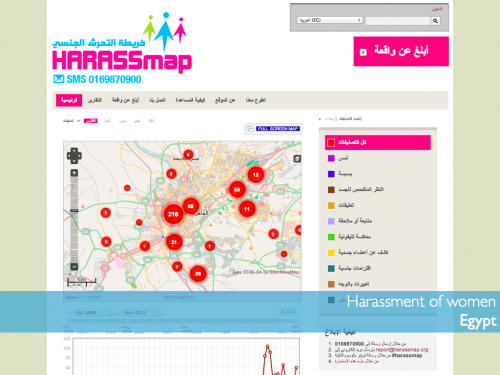
- HarassMap (Ushahidi + FrontlineSMS) – Egypt
- BullyMapper (FrontlineSMS + Ushahidi) – Australia
- Human Rights (Ushahidi) – Saudi Arabia by Amnesty Int’l
- YoungAfrica Live (Internet via mobile) – South Africa
- YETAM (FrontlineSMS + Ushahidi) – Benin by Plan
- Apartheid Watch (Ushahidi) – Israel and Palestine
- Hollaback (Phone cameras and a website) – US, India, Mexico and Argentina
- PeaceTXT (SMS and trained people) – US
- Maps4Aid (Ushahidi) – India
- Take Back the Tech (Ushahidi) – Global
“Across the globe—and without any organizing or mobilization by NGOs or watchdogs—people confronted with threats to their rights are communicating out those experiences, in effect reasserting agency over their own rights protection.” – Amnesty International
Those are all exciting examples, showing what can be done with new technology. Suddenly there are no barriers to entry, anyone can take part, and it doesn’t require that someone have authority to begin. It’s just a matter of figuring out what you want to do and galvanizing a community to take part.
Is technology a panacea? Not at all.
As my friend Clay Shirky says, “The technology only becomes interesting when it is no longer interesting to technologists.”
We use a graphic in Ushahidi to remind users of our tools that the technology is only a small part of any solution. We say that 90% of the work is non-tech related, and can take the form of organizing, outreach, branding, translation, etc.
It’s a reminder to us as well, that we need to focus on creating tools that augment human activity and get out of the way as much as possible. That, in the end, is what makes the earlier examples so interesting; they worked because they used the simple tools available in people’s pockets to interact and bring attention to a much larger population, audience or intermediary.
Just this week a new site was launched, like it’s predecessor in Egypt it’s purpose is to draw attention to the harassment that women get, this time in Ramallah, Palestine. Residents of Ramallah, as well as staff from Palestinian women’s organizations and civil society came together and did something, they built Streetwatch. It was self-organized, it emerged from local needs and tools were found that could suit them.
“They have an opportunity to help themselves and other honest citizens of Ramallah to isolate the problem areas and say no to sexual harassment.”
This is the new story of our time, that:
“Our voices revolutionize the world.” – David Kobia, Ushahidi
Those 5 words. That simple statement.
The revolution is here, you’ve watched it shake industries, rock countries and effect your own community – and what you’re seeing is only the beginning of the massive changes sweeping across the world.
It’s not complicated. It’s the effect of technology democratizing information and changing the way it flows in the world.
It’s simple solutions, by unqualified but driven people, like the communities in Ramallah, Egypt, India and even here in the US, that provide a foundation for the changes that we’re seeing. It’s ordinary people, using simple technology to organize themselves and take care of their own problems.
Your task is to look closely, to understand the basics and then figure out how to use these new tools at your disposal to make a difference. In your case, to specifically prevent violence and help those who have been hurt.
]]> Today Kenya becomes the first country in Africa to launch a national open data initiative. There have been many people pushing for this, over many months, and it’s been an exciting process to watch unfold. Foremost amongst the drivers on this has been Dr. Bitange Ndemo, the Permanent Secretary of Information and Communications. This is indeed a very proud moment for Kenya, and a leading position to take on the continent.
The Kenya Open Data Initiative (KODI) goes live this morning in a big event that includes President Kibaki, as well as many politicians, government officials and local technologists. The World Bank, who has been instrumental in organizing and helping publish the data is here as well, along with Google, Ushahidi, the iHub community and a large selection of youth.
Data Sets
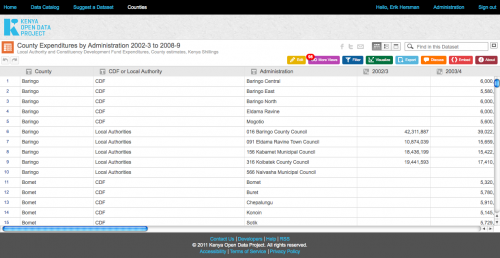
The data is available online through the Socrata platform, which allows users to view different data at national, county and constituency levels. They can compare different data sets, create maps and other visualizations.
Data sets are categorized into 6 main categories: Education, Energy, Health, Population, Poverty and Water & Sanitation. It includes data from the national census, the ministry of education, ministry of health, CDF projects and many more.
Here’s an example of that data, “county expenditures by administration”:
Mashing up the Data
This all came together rather quickly, starting about 3 weeks ago. The tech community was immediately reached out to, and as the data sets have come online over the last week, we’ve had access to them early in order to show what can be done. Here’s a few samples of that.
The Ushahidi team is taking the census data and overlaying healthcare institution data on top of it into our Huduma site. It’s still very beta, but it shows what can be done in just a few days.
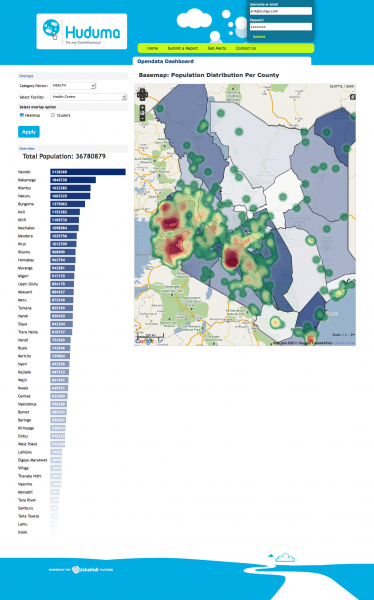
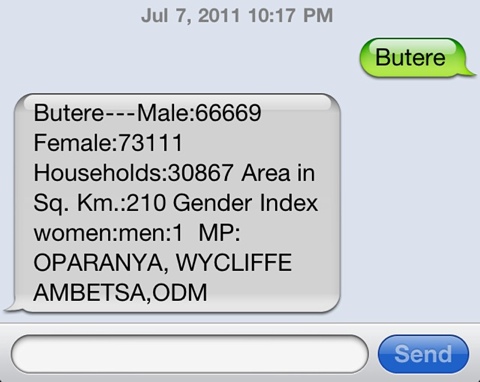
We’ve also built a simple SMS query tool. If you’re in Kenya, send an SMS to 3018 with the name of your county or constituency and you’ll get back an SMS with the demographics and MP of that location.
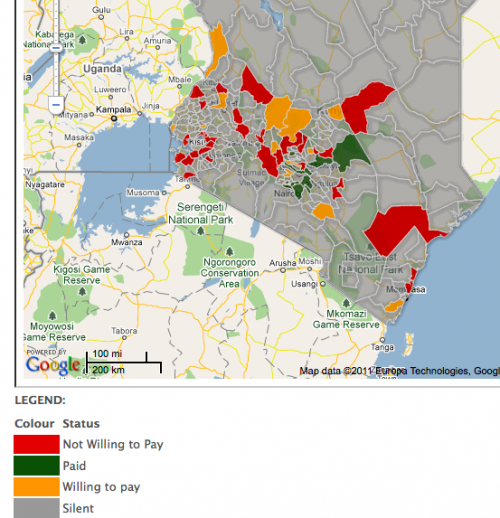
The Virtual Kenya team has built an app that shows which MPs refuse to pay taxes.
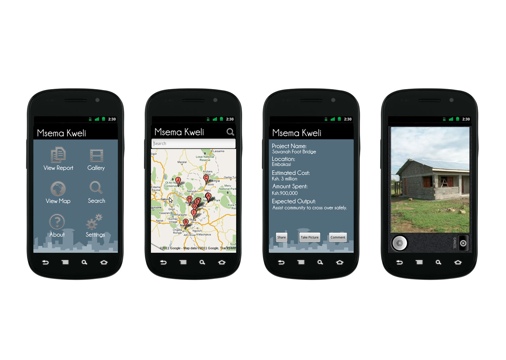
The iHub community has done some things around tracking CDF fund usage in the constituencies. There’s a mobile app called “Msema Kweli” that allows you to find CDF projects near you, and for you to add pictures of them.
Being a builder and a problem solver I wanted to better understand what was going on here. Why, in 2010 did I have to go to one of 7 large shopping centers across town, in Nairobi’s terrible traffic, in order to look at a notice board to find products? With this in mind, I sat down and penned a strategy paper that I thought could address the problem.
(Below is the overview, the full document is to long to post)
The Overview
No organization or entity in Kenya has come up with a good classifieds network. There is little, to no, traction in the online space and the offline arena is a fractured market where each group protects their fiefdom and doesnâ€
There is also no good option for digital classifieds, even though there have been multiple attempts, including Nation Media Groupâ€
This fractured landscape, as well as a missing digital nexus point for classifieds in Kenya, creates a large and open opportunity. Real money is ready to be made, as there are many frustrated buyers and sellers who need an outlet.
In order to succeed at making real money with classifieds listings in Kenya, one needs to have a strategy for both the analog and the digital sides. Itâ€

The document went on for another 5 pages outlining a solution that I thought married up what was needed: a way to mix Kenya’s analog community habits and the efficiencies of a digital solution.
Our Solution
 A couple months later I was discussing this with David Kobia, my colleague at Ushahidi, talking about how there are wide open opportunities like this in Kenya where there is a clear void that no one is filling. It’s not hard, it just takes focus on a simple platform that’s both web and mobile enabled, along with a way to bring in the analog side.
Fast forward a couple of weeks and David built a little site for this purpose over the weekend, called Pigia.me. A place for us to experiment with, and we did. We spent some time gathering classifieds from the shopping centers and the newspaper. We did some Facebook ads. It worked, we quickly got up to over 3,500 listings and traffic was increasing. Total investment 3 days coding and $300 in ads.
But we didn’t have the time. Ushahidi keeps us way to busy, as does the iHub.
Enter Dealfish
About 3 months ago Dealfish, the big classifieds site owned by MIH in South Africa, launched in Kenya. Simultaneously it launched in Nigeria, Tanzania, Uganda and Ghana (English). And in Francophone Cameroon, Ivory Coast, Senegal, and the DRC. They scooped up well-known tech entrepreneur and blogger Moses Kemibaro from Dotsavvy to run East Africa’s operations, while Neil Schwartzman overseas all Sub-Saharan Africa for Dealfish and Stefan Magdalinski presides over Dealfish as well as Mocality and Kalahari for all but South Africa.
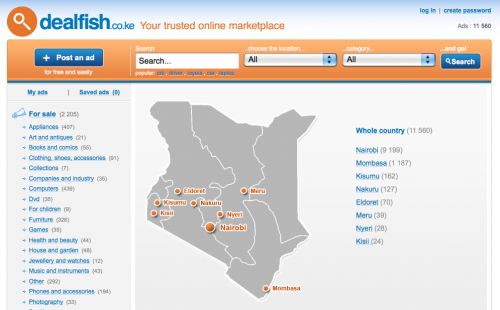
They’re now at approximately 12,000 listings (in Kenya), serving the major urban areas and have about 6000 “answers” per month (which is what they call it when a buyer tries to contact a seller). The top areas are auto, home and jobs – like most classified sites.
Until critical mass is reached, classifieds are something that you have to put a lot of energy towards on a constant and consistent basis. Thus Dealfish has chosen Kenya and Nigeria as their first focus-countries, where they have dedicated personnel.
MIH has deep pockets, and they’ve decided that there is a future in investing in digital arena in the Africa outside of South Africa. They came on strong with online ads by Google, Facebook, Inmobi, Admob and Buzzcity. Inmobi has given them the best return, with Google ads in second place. However, it’s the Dealfish team notes that the Inmobi traffic doesn’t have nearly the same intent to buy or sell as the Google traffic – it’s blind coming in.
Offline Dealfish used radio, in-store advertising, posters in malls and in club bathroom stalls. The form of advertising dictates the type of user, whether they use mobile phones or PC web. In the beginning mobile users were their predominant type, but now it’s split 50/50 between mobile and PC web users.
Dealfish is doing well, and will continue to do so, especially as they have enough financial backing to continue seeding the market. Their competition comes in the form of verticals that are specifically created for a niche market. In this case, autos with Cheki, jobs with Brighter Monday and homes with Property Kenya. And that’s just in Kenya, they’ll fight that same battle in the other markets as well.
Tackling Africa
The only other classifieds system that has made a dent in Africa is Kerawa, operated out of Cameroon. They have thousands of listings in quite a few countries. They’ve done this over the last 3 years, bootstrapped and growing organically.
However, there’s a danger in trying to go after everyone and everything. In the broad classified space there is only a single winner, no prizes for second place, except in niche areas. Whoever reaches critical mass first wins, and the rest can go home. It’s better to win in a couple countries than to lose in all.
Both Dealfish and Kerawa have to fight the very real issue of spam listings. Just letting anything to so as to get bigger numbers only decreases the value to the user. How customer service and clarity of use and value play out to the listing companies and people is where a lot of time and resources can be spent.
[Update: Google Trader launched in Ghana and Uganda to mixed success. As long as there was a lot of marketing put into the effort, they had a lot of listings, as soon as they stopped there was a big drop-off. It’s yet to be determined if Google Trader is a failure or success, or if Google is still putting any more effort into it.]
Urban then Rural
Finally, you have to start in the urban areas due to users, devices and general “mass”. However, if you think that’s enough, then you haven’t learned the lessons taught by the mobile operators. That is, urban is your anchor, but rural is your long tail, your reach.
Any attempt to get enough critical mass to make serious money off of traffic or transactions has to reach beyond the cities. The towns and rural areas are untapped and ripe for the approach. Phase 2 of this approach should look a lot like what I wrote about back in 2009, on how village billboards should be leveraged alongside the mobile phone shops in smaller communities.
]]>9 months ago that is just what Jon Gosier set out to do as he took over the reins of the SwiftRiver initiative at Ushahidi. Today he announces the Beta release, and unveils the new website at Swiftly.org.
What is SwiftRiver?
SwiftRiver Open Beta Announcement. from Ushahidi on Vimeo.
“SwiftRiver is an open source intelligence gathering platform for managing realtime streams of data.”
Using 5 different tools in the toolbox, you can create a host of useful applications. Tools ranging from natural language processing to handling duplicates, or a source’s importance in the ecosystem. Much like a box of Lego’s, the value and usefulness of the apps created are up to the creator.
SwiftRiver lets users:
- Manage realtime data streams (e.g. RSS, SMS, Twitter, Email)
- Identify relationships between content (e.g. email and tweets)
- Set parameters to auto-filter incoming feeds
- Curate content based on preferences
Swift code and web services
Like all Ushahidi work, the code is free and open source, anyone can download it, contribute to the code, and run it on their own server. Due to it’s complexity, SwiftRiver also offers a software as a service solution, allowing you to tap our servers for your own needs. Swift Web Services (SWS) is our cloud platform. The platform offers a number of different APIs to developers. With this platform you can easily beef up your applications with natural language processing & active learning, reverse geocaching, distributed reputation, content filtering and web analytics.

This first app, called the Sweeper is the first project to enter Beta and now ships with SwiftRiver. Sweeper, is a term Ushahidi uses to refer to people who â€sweep†through a system, performing certain tasks, and it was for this reason that we put the Ushahidi resources behind the whole initiative.
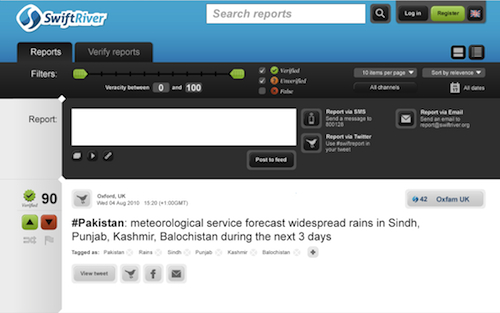
SwiftRiver | Sweeper
History, contributors and code
The origins of SwiftRiver are in the community of Ushahidi developers and users. Chris Blow and Kaushal Jhalla asked some hard questions after the Mumbai terrorist attacks in 2008, discussing the need for something that can help with this information overload we have in the first few hours of an emergency or disaster. Today, we’re seeing the first fruits of that technology, and it’s exciting to know that the potential for it’s use goes far beyond the crisis scenarios that we first envisioned.
Matthew Griffiths (Uganda) and Neville Newey (South Africa) have done a great job hacking out much of the code and designing the architecture for the platform. They’ve been joined by an army of volunteers and contributors, including: Joshua Bronson, Soe, Nishith Rastogi, Mang-Git Ng, Josh Bronson, Ivan Kavuma, Andrew Turner, Chris Blow, Kaushal Jhalla, Ed Bice, Moses Mugisha, Victor Miclovich, Wolfgang Werner, M. Edward Borasky, Maarten J. van der Veen, Ahmed Maawy, Colin Meinke. A huge round of thanks to everyone who gave freely of their time and energy to move this project forward!
Find out more on the website at Swiftly.org
Download the code, v.0.5 Cape Jazz
 DukaPress is a new customized WordPress eCommerce platform. It allows you to easily set up a fully featured online shop which can be used to sell digital or physical goods to customers all over the world.
I’ve been using WordPress for many years, and am a huge fan. When I saw DukaPress last week, I was at impressed to see that it was built locally in Nairobi, but I also wondered why another eCommerce WordPress build was needed, as there are already some good ones out there such as WP-ecommerce and Shopp. So, I asked the Kelvin, from Nickel Pro, and here is his response:
I know you’ve probably been using WordPress even longer than I and the rest of the DukaPress team so I can probably say you know that WP-ecommerce is a bit…buggy (I say this with the highest amount of humility, we are nowhere near achieving what they have). The other free WordPress e-commerce plugins are much less usable, to us, than Wp-ecommerce.
Shopp is really really good but it sits behind a pay-wall – which is okay.
We built DukaPress to be fully featured, yet super simple to use and, well, free. It actually did not start out life as something we’d give out to the public – we built it primarily to serve our own purposes at Nickel Pro because we build a lot with WordPress and when it came to building e-commerce stuff it was always a big problem. One thing led to another and DukaPress, the plugin for public release, was born.
Around the net where WordPress e-commerce is being discussed, there is always a lot of complaints, primarily against WP ecommerce (some people call wp ecommerce a trojan for their ‘for sale’ upgrade), we hope that with DukaPress, people out there have a viable and better (I hope!) alternative.
Other than that, we offer features that none of the other WordPress e-commerce plugins do! As you rightly assumed, we support all three Kenyan mobile payment systems ZAP, yuCash and MPESA! Although I have to qualify that and say that integration of this is still being developed to be more fliud. We’re just at version 1.0.1
How shall we make money with this? We already do, we’ve used it in at least 4 major projects for our client work and it has already paid for itself.
Other than that, we’re currently working on version 2 which will bring full WordPress Multisites support – so that you can build your own etsy.com in 15 minutes – among other features we think are nice. At that point (in the next month or two), we may launch our own etsy.com-type service (or, in better terms, a wordpress.com which can host fully featured shops); or licence the multi-site version of DukaPress for a fee; or both. No other e-commerce plugin has “successfully” pulled off a WordPress Multisites integration to date i.e. users still cannot build a wordpress.com that can host shops without a great amount of hacking.
DukaPress is also a gateway for www.madoido.com.
I think there are certainly similar plugins which may outperform DukaPress but I also do think it probably beats some of the more established ones. I hope the larger WordPress userbase gets to prove me right, but even if they don’t, DukaPress certainly makes our lives easier, and gives a really welcome international perspective to our business.

On a personal level, I’m impressed to see Kelvin and his team at Nickel Pro working on DukaPress, and I hope that they continue to make it better. If you’re a WordPress pro, or in need of an eCommerce solution, check out their website, documentation and features.
]]>